Sometimes you can find surprising things a short distance from home. One day in July 2018, we were driving along in the Corvette. Waiting for a stoplight, we looked up through the open top as we heard the roar of a big airplane and, to our amazement, a B-29 Superfortress bomber flew overhead. There are only two airworthy B-29s flying and this turned out to be "Fifi," which has been flown at airshows and events since 1971. Checking the all-knowing Internet, we learned that "Fifi" had been present at the Gatineau-Ottawa Executive Airport for a show hosted by Vintage Wings of Canada.

On an overcast day in August, the Corvette and I went north across the Ottawa River and eastwards to the Gatineau airport, one of three in the Ottawa area, and soon found myself at the very fancy 23,000 square foot hangar of Vintage Wings of Canada. The organization is a non-profit foundation that acts as a flying museum. It was begun by wealthy tech entrepreneur Michael Potter, who began collecting vintage aircraft in 2000 before making arrangements more formal with the foundation, which acquires, manages, maintains and flies the aircraft with professional personnel. Vintage Wings is open to visitors on Saturdays from 0900-1500 for a $10 donation.
 |
| Rolls-Royce Merlin engine originally used for technician training |
 |
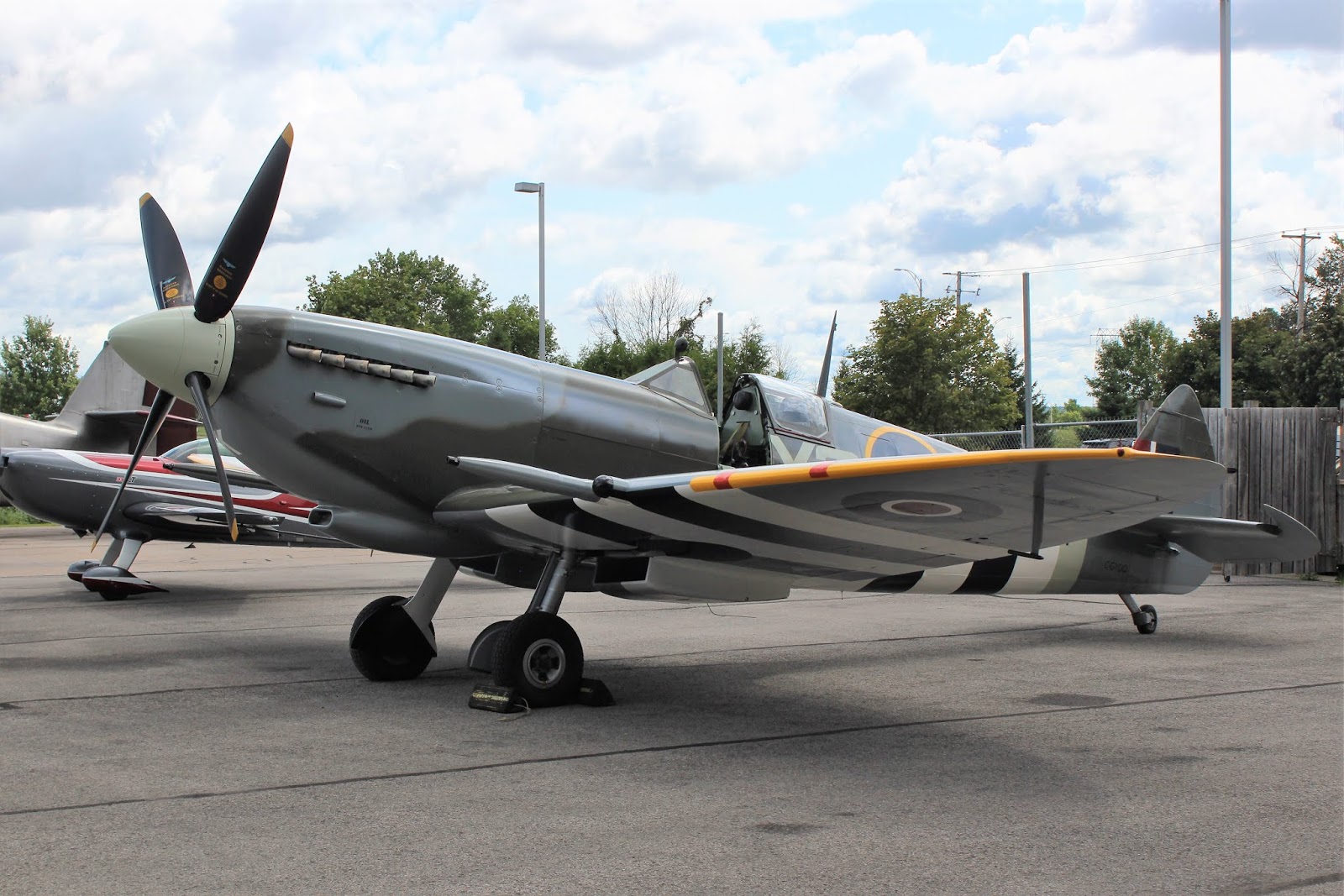
| Vickers Supermarine Spitfire Mk. IX |
 |
| North American Mustang IV |
 |
| Curtiss P-40N Kittyhawk |
 |
| Hawker Hurricane Mk. IV |
 |
| Hawker Fury undergoing restoration |
Considered one of the most beautiful biplanes ever designed, the Hawker Fury interceptor was introduced in 1931 and was the first fighter in Royal Air Force service to exceed 200 mph in flight. Powered by a Rolls-Royce Kestrel engine, around 275 were built and operated not only with the United Kingdom but with several other air forces. The last Furies were mustered out of service by Iran in 1949.
 |
| Vintage Wings' comprehensively equipped workshop |
 |
| Westland Lysander IIIa |
Originally designed as an army cooperation aircraft in 1936 but soon obsolete in that role, the Lysander's exceptional short field performance saw it used for covert operations primarily contacting the French Resistance. 225 Lysanders were built in Canada and were supplemented by 104 British-built examples and were used for a variety of roles, including training (at RCAF Station Rockcliffe here in Ottawa), anti-submarine reconnaissance and, for a brief period when all Hurricanes in Canada had been sent to Britain momentarily leaving no fighters in this country, were redesignated as fighters although never equipped in any way for that. Lysander service in the RCAF was already ended by 1944. The IIIa variant at Vintage Wings would have been used as a target tug.
 |
| Fleet Model 16 Finch II |
 |
| de Havilland Chipmunk |
 |
| North American Harvard Mk. IV |
 |
| Boeing PT-27 Stearman |
In addition to the combat aircraft, Vintage Wings has examples of the aircraft used for the British Commonwealth Air Training Plan, all in their distinctive yellow finish.
There are a number of civilian aircraft in the Vintage Wings hangar as well, including one of my favourite aerobatic planes, the little Pitts S-1T.
I had the opportunity to speak to the owner/pilot of the Pitts, Peter Ashwood Smith, and mentioned that many years ago I had an hour of dual instruction in a two-seat Pitts S-2A not far from Boston and he knew the pilot, Dr. Gunther Eichhorn. Peter noted that the Pitts community of competition pilots was pretty small.
 |
| Extra EA-330LT Aerobatic Aircraft |
Extra Flugzeugbau of Dinslaken, Germany, manufactures the Extra EA-330LT, a development of the Extra 300 two seat aerobatic airplane that first flew in 1988. It was designed by Walter Extra (yes, that really is his name) and is capable of competing in the Unlimited Competition category. It is quite fast and, at around US$450,000 not inexpensive.
 |
| Attawapiskat Annie (Antonov An-2) |
With more than 21,000 examples built between 1947 and 2001 (!), the An-2 was developed as a utility/agricultural aircraft and is capable of carrying twelve passenger. The example I saw in Gatineau has been used for emergency relief operations in Northern Ontario, a story told
here.

 |
| Sukhoi Su-26M |
Since its introduction in 1984, the Sukhoi Su-26 and its successor aircraft have been considered the dominant machines in world aerobatic competition. The Su-26M is unusual in being powered by a radial engine, the Vedeneyev M14P nine cylinder engine of 360 hp.
 |
| de Havilland Canada DHC-2 Beaver |
A true classic, this de Havilland DHC-2 Beaver was recondition by Viking Air Ltd. in British Columbia, which holds the type certificates for all post-war de Havilland Canada aircraft. Viking acquired the jigs and drawing for the Beaver in 1983. Over 1,600 examples were built between 1947 and 1967 using the Pratt & Whitney R-985 radial engine. My guide told me that Michael Potter sold his Beaver but regretted it and got this one soon afterwards. This is, without doubt, the finest example flying.
And so ended by day at Vintage Wings of Canada. I have since seen a number of flybys, including a flight of three fighter planes marking the anniversary of the Battle of Britain, as well as a flight by the British demonstration team, the Red Arrows, as part of the Aero-Gatineau airshow.