Showing posts with label Dearborn. Show all posts

Saturday, June 18, 2016

Greenfield Village and the Motor Muster: June 18, 2016


Driving back to Dearborn, our afternoon was spent at Greenfield Village, the outdoor "living history" museum adjacent to the Henry Ford Museum.  It was opened to the public in 1933 and was the first outdoor museum of its kind in the United States.  It comprises 240 acres, of which 90 are for exhbitis and the remainder being natural landscape.

In addition to the 100 buildings to be visited at the site, Greenfield Village also hosts a number of special events, including two car shows.  There is one for early cars (1890-1932) each September and the Motor Muster, for cars built between 1932-1976, which we were fortunate in our timing to be able to see.

Upon entering the park, we could not resist taking a ride on the beautiful vintage steam train, the Weiser Railroad, that circles the village.  It has a 2 mile route and four stops and the beautiful roundhouse is a modern replica of one built in 1884.  Our locomotive, one of three in inventory, was "Edison," built in 1870.


Something a bit unusual: Amish tourists
As the train circled Greenfield Village, we had a nice view of the many attractions.  One of these is an old time baseball field, where a game was in progress.  The players stopped briefly to tip their caps and wave to us.  Greenfield Village keeps traditional "base ball" as it is called alive and hosts the World Tournament of Historic Base Ball each August.  There is a Vintage Base Ball Assocation and teams are fielded throughout the USA.  This version of the sport is pre-the professional era in style and values sportsmanship.  The gentleman's game does not appear to use protective gear or even gloves but the outfits are very nice.  The Greenfield Village team is The La-De-Dahs.


Passing farmsteads and a lovely covered bridge, we arrived at our station and prepared to enjoy the sights and sounds of Greenfield Village and the Motor Muster.  It was a very hot and sunny day and everyone was in good spirits.


1832 Ackley Covered Bridge, formerly in Southwestern Pennsylvania


In the centre of the village a reviewing stand had been set up and the cars of the Motor Muster, in order of year of manufacture, slowly advanced, stopping before the panel of commentators who provided the story behind the vehicle.  

1956 Continental Mark II

1957 Ford Thunderbird
After watching the cars drive by--and we would have the chance to look at them more closely as they were parked throughout the village--we decided to start looking at the different buildings on offer.
For me one of the great treasures of the village is the Wright Brothers' bicycle shop, moved to Michigan from its original location in Dayton, Ohio.  It was accompanied by the brothers' boyhood home as well.


The Wright house, built in 1870.  It was here that Orville was born in 1871 and Wilbur died in 1912.


There were, unsurprisingly, many objects related to Henry Ford.  In addition to the numerous Ford Model Ts zipping around the village ($5 a ride and remarkably quiet), there was a scaled replica of Henry Ford's first factory, which contained the 15 Millionth Ford car, as well as the original workshop where he built his first car, the Quadricycle, in 1896.


In a courtyard next to the Quadricycle workshop/shed there was a demonstration of the "kitchen sink" engine, the model that Henry Ford built for his car based on plans in a magazine.  To test it, he bolted it to the kitchen sink and ran it there.  It was fascinating to see this early technology in action, with fuel having to be dripped down into the engine as there was no such thing as a carburetor yet.

As an aside, the plans that Henry worked from had been drafted by a rather crooked promoter of early car companies and it is considered remarkable that given his history it actually worked!


Another demonstration was a real chance to history in action.  Henry Ford was a huge admirer of Thomas Edison, having worked for him as an engineer, and a big celebration was held in Greenfield Village in 1929 marking the fiftieth anniversary of the invention of the electric light, surely a major milestone for humanity.  Edison himself was present for the event, which took place in Greenfield Village's reconstruction of Edison's Menlo Park, New Jersey, laboratory complex.  The buildings are filled with interesting objects as they would have been in Edison's time.  The chair where he sat for the ceremonies was nailed to floor, Ford saying it would never be moved.  At one point the floors were replaced but the area under Edison's chair remains as it was.


Edison's chair is on the left; note the original floor!
In addition to all the electrical and chemical equipment found in the lab buildings, we were given a demonstration of Edison's phonograph, which required the user to speak into a trumpet while a needle recorded the sound on tinfoil.  The demonstrator recited "Mary Had a Little Lamb," just as Edison himself did in 1877, and played back the faint, tinny recording.  Edison did not see much future for his invention except as a dictaphone but this little device led to our vast treasury of recorded sound.  The replica phonograph used for the demonstration was made by a mechanic from Michigan and donated to the museum in 2014.

The demonstrator was so pleased by our interest in the device that he gave us the tinfoil sheet used to make the recording.


Old Henry Ford was so keen on Thomas Edison that he even arranged to have the Canadian home of Edison's grandparents brought from Vienna, Ontario, to Greenfield, Village.  I had to look it up: Vienna is a tiny village near Lake Erie, around 60 kms southeast of London, Ontario.  There is actually an Edison Museum on 14 Snow Street in Vienna which has family mementos.  However, "due to structural deficiencies the Edison Museum has been closed indefinitely."

Edison home, relocated from Vienna, Ontario
We continued our walk through the village, stopping to admire the many beautiful old cars on display.

1948 Cadillac convertible

1962 Lincoln Continental sedan


Volkswagen Beer Truck, sadly with only empty cases

1930s Dodge

American Bantam cars, built on imported Austin components


1964 Lincoln Continental limousine used by Pope Paul II on his visit to the United States, a new acquisition by the Henry Ford Museum in 2016
Not only were interesting cars parked throughout the village, but there was live entertainment as well. A group in costume performed various songs from the 1920s and 1930s, including some familiar Gershwin numbers.


And as it was very hot we looked for some refreshment.  There is a a very fine old tavern on the grounds.  Originally constructed as the Clinton Inn in 1831 and renamed the Eagle Tavern in 1849, it serves authentic food from the period and is a popular dining spot.  I chatted with the proprietor and his friend and was persuaded to try the tavern's homemade sarsparilla, which was very welcome and refreshing.  Someone has written an excellent blog about Greenfield Village and offers up this detailed history of the Eagle Tavern here.


At the end of the day there was a Sixties Dance Party on the main street.  A British DJ was chauffeured to the grandstand and a group of young people danced vintage dances from the era of the British Invasion.  A group came on stage and lip-synched to "I'm Telling You Now," the one big hit of Freddy and the Dreamers.  Subsequently, the dancers were instructed to "do the Freddy," a dance that would take a gold medal for awkwardness.  It was all good fun.


Doing the Freddy
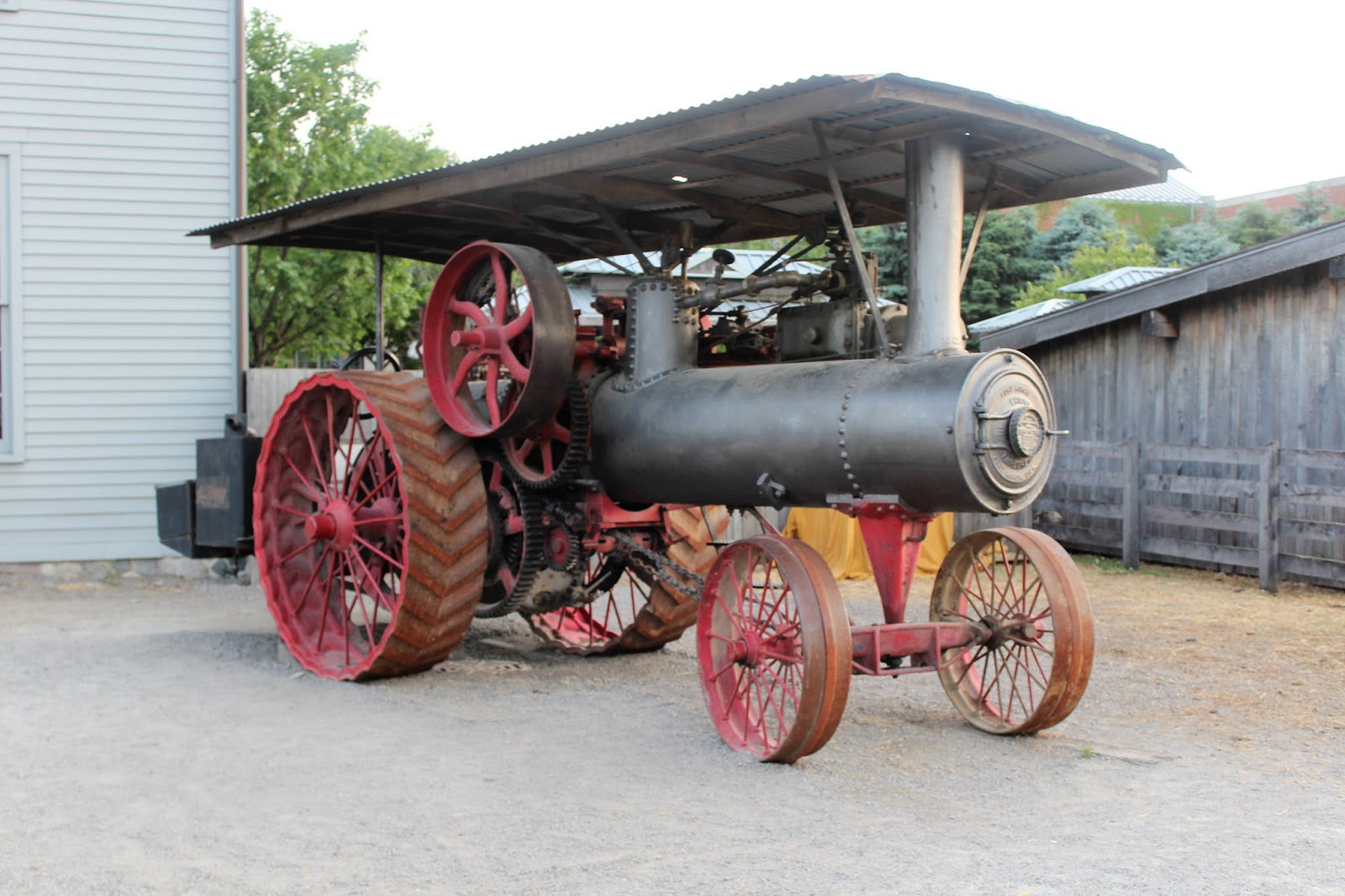
Tired but happy, we made our way past a lovely mill and a wonderful steam tractor and headed for the exit.  We spend a half day in Greenfield Village but will return as there was so much we did not have a chance to see.  Henry Ford famously remarked "History is bunk" but in his later, declining years spent a lot of time just hanging around in Greenfield Village.  One has the sense that the man who put the world on wheels, who was responsible perhaps more than anyone else for the modern world in so many ways, wanted to somehow put the genie back into the bottle and return to a quieter age.


Friday, June 17, 2016

Oh, Henry! Our Visit to the Henry Ford Museum of American Innovation, Dearborn, Michigan, June 17, 2016


Following our visit to the Ford Piquette Avenue Plant, we left Detroit proper and drove to Dearborn, a short distance away.  Rather than the unkempt and desolate area we saw with its abandoned factories on Piquette, Dearborn looks highly prosperous.  It was the hometown of Henry Ford and bears strong witness to this interesting, forceful, visionary, and maddening individual who was, in his time, the most famous man in the world, and amongst the richest.

For someone who famously declared: "History is bunk" his construction of what is formally called The Edison Institute (but better known by its constituent parts of the Henry Ford Museum of American Innovation and Greenfield Village) seems inconsistent but he preferred to see history in the accomplishments of the everyday rather than the works of Great Men.  Hence, his declaration on the rationale for the Institute: "I am collecting the history of our people as written into things their hands made and used.... When we are through, we shall have reproduced American life as lived, and that, I think, is the best way of preserving at least a part of our history and tradition..."

The museum, which is referred to as "the Henry Ford," is a 12 acre building modeled on Independence Hall in Philadelphia, and which contains an absolutely eye-popping collection of antique machinery, automobiles, locomotives, steam engines, airplanes, and odd items of popular culture.  The exhibition space totals nine acres.  It was finished in 1929 but only opened to the public in July 1933 and receives 1.6 million visitors along with Greenfield Village each year.  There are separate admission charges for the two attractions and on this day we just did the museum.

We entered the museum at the exhibit devoted to Presidential vehicles, which ran from Theodore Roosevelt's 1902 coach (he did not like cars, apparently) to the 1972 Lincoln Continental limousine used by Ronald Reagan.  The most noteworthy of the five vehicles on display is, of course, the 1961 Lincoln Continental in which President John F. Kennedy was assassinated on November 22, 1963 in Dallas.  This car, which was not armoured, was retained in government service until 1977 but considerably modified with titanium armour and a permanent roof.


1939 Lincoln Presidential limousine, "the Sunshine Special," used by Franklin D. Roosevelt


1950 Lincoln Presidential limousine built for Harry S Truman but more closely identified with President Dwight D. Eisenhower, who added the distinctive plastic bubble top

1961 Lincoln Continental Presidential limousine, one of the most famous cars in history


Leaving the Presidential vehicles, we found ourselves in "Heroes of the Sky," perhaps the best assemblage of historically-significant aircraft in the United States after the Smithsonian Air & Space Museum, although admittedly on a smaller scale.

Henry Ford was a pioneer in commercial aviation and his Ford Trimotors, built from 1925 to 1933, was an important step in aviation by offering a reliable, rugged, all-metal aircraft suitable for airline use.  By the late 1920s, the Ford company was considered the largest manufacturer of commercial aircraft in the world although in the end Ford made no money with its airplane subsidiary.  On display is the "Floyd Bennett," a 1928 Trimotor used by the Byrd Expedition for the first flight over the South Pole on November 28.29, 1929.


Ford Trimotor with contemporary Chrysler Imperial
In addition to not making money in the airplane business, Henry Ford was apparently distressed by the death of his test pilot and close friend, Harry Brooks, in the crash of the Ford Flivver, in 1928. This airplane was meant to be an everyman's airplane, a flying Model T, and Brooks set several speed records in its weight category.  Charles Lindbergh was the only other person to pilot one of the five Flivvers built and he described it as "one of the worst aircraft he ever flew."  The Flivver in the museum is the sole surviving original and two replicas have been constructed.  Surprisingly, another attempt was made to build a mass-market airplane by Ford but the flying wing design 15P, powered by a Ford V-8, and completed in 1936, never advanced beyond a single unsuccessful prototype.

1926 Ford Flivver
There is a great deal of controversy over Richard Byrd's claim to be the first to fly over the North Pole in 1926 but no matter the ultimate truth, the expedition was financed by Edsel Ford and Byrd named the 1925 Fokker F.VII Trimotor after Ford's daughter Josephine and it is on display at the museum as well.


Although it is not listed as a "highlight" of the gallery, I was impressed by Dayton-Wright Racer, an airplane years ahead of its time when built in 1920.  Featuring a clean cantilever wing (no wingstruts) with variable camber and retractable landing gear, it was shipped to France for the 1920 Gordon Bennett Cup air race but a cable failure meant it could not complete the event--the only time it ever participated in an air race!

Note the "RB" logo on the lower cowling.  The Dayton-Wright Racer's designers were Howard Rhinehart and Milton Bauman.  Pilot visibility was pretty much non-existent. 
Also of particular interest are a pair of rotary wing pioneers.  Juan de la Cierva was a Spanish inventor who developed the autogiro, a helicopter forerunner in which the blades are not powered but develop lift with the forward motion of the aircraft, enable very short take-offs and landings but not true vertical ones.  A license was to manufacture Cierva autogiros in the United States was obtained in 1928 by Pitcairn Aircraft, a builder of mailplanes, and received considerable publicity as it produced a line of autogiros.  In 1931, the Detroit News purchased a PCA-2 for use as a news aircraft and this aircraft is on display in Dearborn.


The next step in rotary-winged flight was the true helicopter and the Henry Ford Museum has a true jewel in that it exhibits the first truly practical helicopter, the 1939 Vought-Sikorsky VS-300A, which first flew on September 14, 1939.  It has been in the museum since 1943, except for a return to Sikorsky Aircraft for restoration in 1985.


Now, turning away briefly from transportation machinery, we came across a showcase that featured Henry Ford's violins.  This came as a surprise because while I knew that he was keen on old-time dance music and liked fiddles, even learning to play a bit, once he was fabulously wealthy he could indulge his interest more broadly.  In addition to building a fancy ballroom, Lovett Hall, for dances, he acquired a number of remarkable violins.


It was clear that these were indeed very fine instruments and looking at the labels I discovered two Stradavari violins from that master's "Golden Age," an Amati and a superb Guarneri del Gesu.  Henry Ford would loan them out to anyone who admired them.  It is unfortunate that they are now in this showcase unplayed.  Even stranger is to think of them being used for country dances and a rousing chorus of "Turkey in the Straw!"


Cremona violins are great (even if not exactly "American Innovation") but if you go to the Henry Ford you should expect a really good collection of automobiles and in this respect there is no disappointment when you enter "Driving America."

1896 Ford Quadricycle Runabout: Henry's Job No. 1

Of course, given the museum's background it is not surprising to see Henry Ford's first car, which has lots of folklore connected to it.  The engine was run in the kitchen (nicknamed "the kitchen sink engine") and when the vehicle was completed Ford had to rip down part of the shed it was in to be able to get it out.  We were impressed that the museum does not focus only on the Ford Motor Company but has a highly representational collection of important vehicles, including the oldest surviving American automobile, the 1865 Roper Steam Carriage.  It was built in Roxbury, Massachusetts by Sylvester Roper, who apparently built a series of lightweight, steam-powered vehicles between the 1860s and 1890s--including a steam-powered motorcycle!

1865 Roper Steam Carriage
Early on Henry Ford became very interested in racing cars as a way to attract investors.  After his first company, the Detroit Automobile Company, failed he set out with associates to build a new car to get attention.  In 1901 he raced his "Sweepstakes" car against established manufacturer Alexander Winton at a dirt horse racing track in Grosse Pointe, Michigan, and, to everyone's surprise, won the 10 miles race.  He sold the car in 1902 but bought it back in the 1930s, installing a reproduction body.  It served its purpose as soon after the race Henry Ford had new backers and a new company, the Henry Ford Company.


1901 Sweepstakes Racing Car


1902 Ford 999 Racing Car

Newly relaunched, Henry Ford continued to disappoint his backers as he worked further on racing cars rather than the practical passenger cars they were hoping he would develop.  The result was a pair of racing cars, the famous 999, named after a famous steam locomotive of the day, and a sister car, the Arrow.  These were brutally primitive cars,weighing 2370 pounds and having a massive 1156 cubic inch inline four cylinder engine (roughly triple the displacement of the 6.2 litre V-8 in my Corvette), no transmission or suspension, and a single brake acting on the rear axle.  Afraid to drive the car (with good reason, I think!), Henry Ford hired the celebrated bicycle racer Barney Oldfield, who bought the car for $800 and raced successfully against the luckless Alexander Winton in the Manufacturers' Cup Race in October 1902.  The story goes that Oldfield had only learned to operate the car the morning of the race, never having driven a car before!


Barney Oldfield at the tiller of 999, with Henry Ford, December 1902

In any event, while the car brought fame to Henry Ford, it did nothing for his partners and he was soon out of his second company, which was renamed the Cadillac Automobile Company, but he was allowed to use his name for his next venture, the still-existing Ford Motor Company.  Third time lucky!

Henry Ford achieved immortality (and staggering wealth) with his legendary Model T (please see my posting on the Ford Piquette Avenue plant where it was developed) and the museum has an unusual take on this famous car.  There is an exploded Model T, showing the simplicity of the design.


Nearby is a really fun exhibit: every day a Model T is assembled by visitors and then disassembled in preparation for the next day!  When we visited the car was completed (for something like the 2500th time) but at least I was able to sit in a Model T for the first time.


The Model T was so dominant and such good value that it rapidly drove out competitors that could not match it for price or performance.  This was the time of the cyclecars, introduced from Europe in 1912.  They were extremely lightweight and cheap, using motorcycle engines, but quickly eclipsed by the Tin Lizzy, which was a paragon of solidity in comparison.

1913 Scripps-Booth Rocket Cyclecar Prototype, constructed in Detroit
The early days of the automobile saw a lot of innovation and experimentation.  The Henry Ford Museum features some of these developments, including steam and electric cars.  The Woods Motor Vehicle Company of Chicago, concerned about the declining sales of its electric vehicles, came up with a hybrid gasoline-electric car in 1916, supposedly to take advantage of the best aspects of each power system, but the company was gone by 1918.

1916 Woods Dual-Power Hybrid Coupe
In the early days of motoring, roads in the United States were pretty terrible (if they even existed) so it took brave souls to undertake long-distance adventures.  The museum has the second car to cross the United States, a 1903 Packard Model F, which took 61 days to get from San Francisco to New York.  It was driven by the Packard plant foreman (accompanied by a journalist), who remarked about the journey: "It was hard, very hard, and I do not care to make the trip again."

1903 Packard Model F Runabout

Packards were noted for their quality and durability and the museum has several, including a very fine 1904 Model L Touring Car, one of the first cars to be built in Detroit after investors moved the company there from Ohio, and the first Packard to bear the distinctive tombstone-shaped radiator shell.


And let us not forget more utilitarian vehicles: the museum also houses the very first Bluebird school bus!


Motor vehicles advanced at a remarkable rate.  A very nice display covered the gamut of luxury cars, from an early Rambler limousine to the great cars of the 1930s to the 1956 Continental Mk II.


1931 Bugatti Type 41 Royale  Convertible, one of the six extravagent Royales built

1931 Duesenberg Model J Convertible Victoria, body by Rollston
"Driving America" is divided into different themes, so in addition to early cars, racers, and luxury cars there is a section on design, which includes the Chrysler Airflow, the Tucker 48 and other ground-breaking forms.  I am particularly fond of the original Lincoln Continental, conceived by Edsel Ford, and the 1941 example was his personal car, used until his untimely death in 1943.


1937 Chrysler Airflow Sedan, the final year of production of this short-lived model

1948 Tucker Sedan

Edsel Ford's 1941 Lincoln Continental Convertible

These are only some of the highlights of "Driving America," and here are some other favourites:

1906 Thomas Flyer Touring Car, a very high quality vehicle produced by the E.R. Thomas Company of Buffalo, New York, and to become famous in 1908 when one of Thomas' cars won the New York-Paris Race
1906 Rapid 12 passenger bus, produced in Pontiac, Michigan.  GM bought up stock in the company and by 1912 it formed part of the General Motors Truck Company (now the GMC brand)
In the foreground is the mid-engined two-seat 1962 Mustang I Roadster, a concept car that was disregarded in favour of the more prosaic 1965 Mustang (Serial No. 1) in the background, which was an incredible sales success
1965 Goldenrod Land Speed Record car, which broke the record for wheel-driven (vs. jet or rocket cars) at 409.277 mph (655.68 km/h), a record that stood until 1991.  The car used four Chrysler Hemi V-8s, producing 600 hp each.
The museum has far, far more to be seen including Early American furniture, the chair Lincoln occupied the night he was shot at Ford's Theater, a massive range of stationary steam engines, including a very early Newcomen Engine, all kinds of farm equipment, and steam trains.


And rounding up this quick overview of our day at the Henry Ford Museum of American Innovation, what could be better than the wacky Dymaxion House conceived by the inventive Buckminster Fuller? 
Developed to address perceived shortcomings in house design, it was meant to be produced in a factory and assembled as a kit on site--on any site.  The prototype was manufactured by the Beech Aircraft Corporation, that had experience in aluminum construction and hoped to diversify as the market for light aircraft collapsed in 1948.  For various reasons the Dymaxion did not catch on but exhibits many interesting ideas, including prefabricated bathroom modules.  It was donated to the Henry Ford Museum in 1990 and after painstaking reconstruction became an exhibit in 2001.  You can take a virtual tour of this intriguing house here


.
Our afternoon at the Henry Ford Museum flew by and we did not manage to see everything.  I would highly recommend it as one of the more imaginative places to visit!