The Gilmore is very unusual in that it offer a central museum building but is surrounded by outbuildings that have been set up by special interest auto groups, such as marque groups such as the Model A Ford Foundation or the Cadillac LaSalle Club, and, with the Classic Car Club of America, an entire era. There are special areas for Lincoln and Franklin but the Gilmore also has special exhibitions. The variety of cars and trucks is astounding.
On entering the main Heritage Center building, we came to the first exhibition area, which was dedicated to "Michigan's Other Motor City," Kalamazoo, which is only 30 kms (17 miles) from the museum. Perhaps the best known brand was Checker, one-time builder of big taxicabs, but in fact over time Kalamazoo had no fewer than 17 car manufacturers and a nice cross section was shown at the Gilmore.

 |
| 1899 Locomobile Steam Runabout |
The first "horseless carriage" to come to Kalamazoo, this Locomobile was built in Waterford, Massachusetts from designs originally conceived by the Stanley Brothers. The purchaser, a Mr. Taylor, was so nervous about driving on city streets that he had the car towed to his barn by horse and then proceeded to teach himself to drive using company literature as he had no other instruction. Afraid of scaring passing horses, Mr. Taylor simply drove the Locomobile back and forth in his barn until it was seen by Dr. W.E. Upjohn, who offered to drive the car and made several trips around the yard. He was so thrilled with it that he purchased the car from Mr. Taylor, making this Locomobile the first new car as well as the first used car sold in Kalamazoo. Dr. Upjohn, the stepfather of Donald S. Gilmore, was the founder of the Upjohn Pharmaceuticals company.
 |
| 1903 Michigan Runabout |


 |
| 1912 Michigan Model K |
Not to be confused with the Michigan Automobile Company (although you can bet it was), the Michigan Motor Car Company began building cars in 1909. The firm was an outgrowth of the Michigan Buggy Company, founded in 1883. Things did not go so well for the makers of "the Mighty Michigan" even with the catch slogan "Take a spin in a Michigan!" as the company was bankrupt by 1913 and the Chief Financial Officer ended up in Leavenworth Prison. The Michigan was an assembled car, with only the bodies being manufactured by the company, and it is thought that around 7,200 were put together before the financial collapse. Perhaps a dozen are known to exist today. The Model K, with its 40 hp Buda engine, was considered the mightiest of the Michigans. There is a nice website by a family restoring their own Model K, which has been in their possession since new!
Kalamazoo's auto ambitions had crashed off the road momentarily thanks to the failure of the Michigan Motor Company but in that era of wild exuberance in the car industry there was more to come. Enter the Barley Motor Car Company and its Roamer, billed as "America's Smartest Car."
Kalamazoo's auto ambitions had crashed off the road momentarily thanks to the failure of the Michigan Motor Company but in that era of wild exuberance in the car industry there was more to come. Enter the Barley Motor Car Company and its Roamer, billed as "America's Smartest Car."


 |
| 1921 Roamer Speedster |
 |
| 1920 Roamer Sport Touring Car |

 |
| 1921 Roamer D-6-54 Town Car Landaulet, coachwork by H.R. Chupurdy of New York |
 |
| 1920 Roamer Sport Touring Car Model C-6-54 |
The Roamer was fast and stylish, with a nickel-plated grille reminiscent of the Rolls-Royce. A variety of engines were used, beginning with a Continental six. A switch to the four cylinder Rochester-Duesenberg engine in 1920 saw a Roamer set a passenger car speed record of 105 mph in April 1921 on the sands at Daytona. The cars were very expensive, with an R-D-engined Roamer touring car listing at $5,300.
In 1922 a lower-priced line of cars was introduced but the Barley, named for the firm's president, was not terribly successful. Priced from $1,500 to 2,250, the Barley offered several body styles, all powered by a 50 hp Continental engine. By 1924, the financial situation was such that the company was reorganized, with A.C. Barley selling his Roamer interests. Roamer production was supposed to be transferred to a new company in Toronto, while Barley manufacturing remained in Kalamazoo but only lasted from 1922 until 1923. An attempt to turn unsold Barleys into yet another brand, the Pennant, for the taxicar market (thereby competing with Checker, another Kalamazoo car company), did not succeed. In 1927 the Roamer returned to Kalamazoo and A.C. Barley was at the helm once more. Roamer was no longer able to source Duesenberg engines or the Lycoming eights that had also been used and production and sales of "assembled" cars were declining in any event. A.C. Barley subsequently bought the Rutenber Motor Company, of which his family had been major shareholders, to use its plant in Peru, Indiana, to build truck engines but in 1929 he closed down the Roamer factory in Kalamazoo. Although information is not very clear on this, it seems only two Roamers were built in 1929, having fallen from a mere 38 the previous year. It is thought that around 2,000 Roamers were built from 1916 until 1929.
 |
| 1923 Barley 6-50 Touring Car (left), 1922 Handley-Knight Touring Car (centre), 1922 Dort Sedan (right) |
There are only two Barleys known to exist and the Gilmore Museum has both of them: a nicely restored 1923 touring car and an original 1924. The other rarity on display was a Handley-Knight Model B, also produced in Kalamazoo, and using the Knight sleeve-valve engine. The Handley company (with financial support from the omnipresent Dr. Upjohn!) operated from 1921 to 1923, when its assets were purchased by Checker Motors. Only three Handley-Knights are known.
 |
| 1922 Dort 5 Passsenger Sedan |
J. Dallas Dort was the business part of Billy C. Durant, the founder of General Motors, when together they owned the biggest carriage company in the United States, the Durant-Dort Carriage Company, in Flint, Michigan. Durant left the firm in 1905 but Dort decided to remain with the horse-drawn vehicles until 1915, when he went with the times and began motor vehicle production, producing around 105,000 cars in both four- and six-cylinder varieties until his retirement in 1924. Closed Dorts, such as the Gilmore's sedan, were built in a plant in Kalamazoo, while other Dorts were built at the Flint works. The Kalamazoo factory was taken over by Checker Motors, while the Flint one was purchased by the A.C. Spark Plug concern.
 |
| Checker Taxicabs |

Perhaps the most memorable (and certainly the longest-lived) of all Kalamazoo car companies was the Checker Motors Corporation. Russian immigrant Morris Markin, who had made his money providing uniforms for the US Army, accidentally found himself the owner of a car business when a loan he made to an auto body firm in Chicago was in default. He acquired that business in 1922, along with its primary customer, Commonwealth Motors, which sold finished cars to the taxi industry. In 1923, Markin moved his automobile business to Kalamazoo, partially to take advantage of the underutilized Handley-Knight factory and the surplus Dort plant but also to get out of the line of fire in gangster-infested Chicago, where a mob war was being fought in the taxi business. Mr. Markin named his company "Checker" although it was unrelated to the Checker Taxicab Company in Chicago, a firm controlled by John Hertz (of later car rental fame). Markin eventually gained control of much of the taxi business in New York and Chicago and his business machinations are quite something to read about. For a time Checker was connected with the Cord Corporation (the holding company that controlled the maker of Auburn, Duesenberg and Cord cars, in addition to a range of other companies) through financial operator E.L. Cord, but when the Securities Exchange Commission took a dim view of Cord's business activities he sold out in 1936 and Markin was in control of Checker once again, even as production of Auburns and the other brands faded.
The Checker operation in Kalamazoo was never huge but was profitable and over the years various models were offered, using drivetrains brought in from other manufacturers, and while they became steadily more obsolete, Checker cabs were a symbol of New York and other big American cities. Production of the cars ended in 1982, although the company continued to produce parts for the auto industry, primarily metal stampings for General Motors, but in 2009 Checker Motors succumbed to GM's restructuring problems and the recessionary economy, going into bankruptcy in January of that year. The Gilmore Museum possesses a 1923 Checker taxi, donated by Morris Makin's son in 2010.


 |
| 1914 Cornelian |
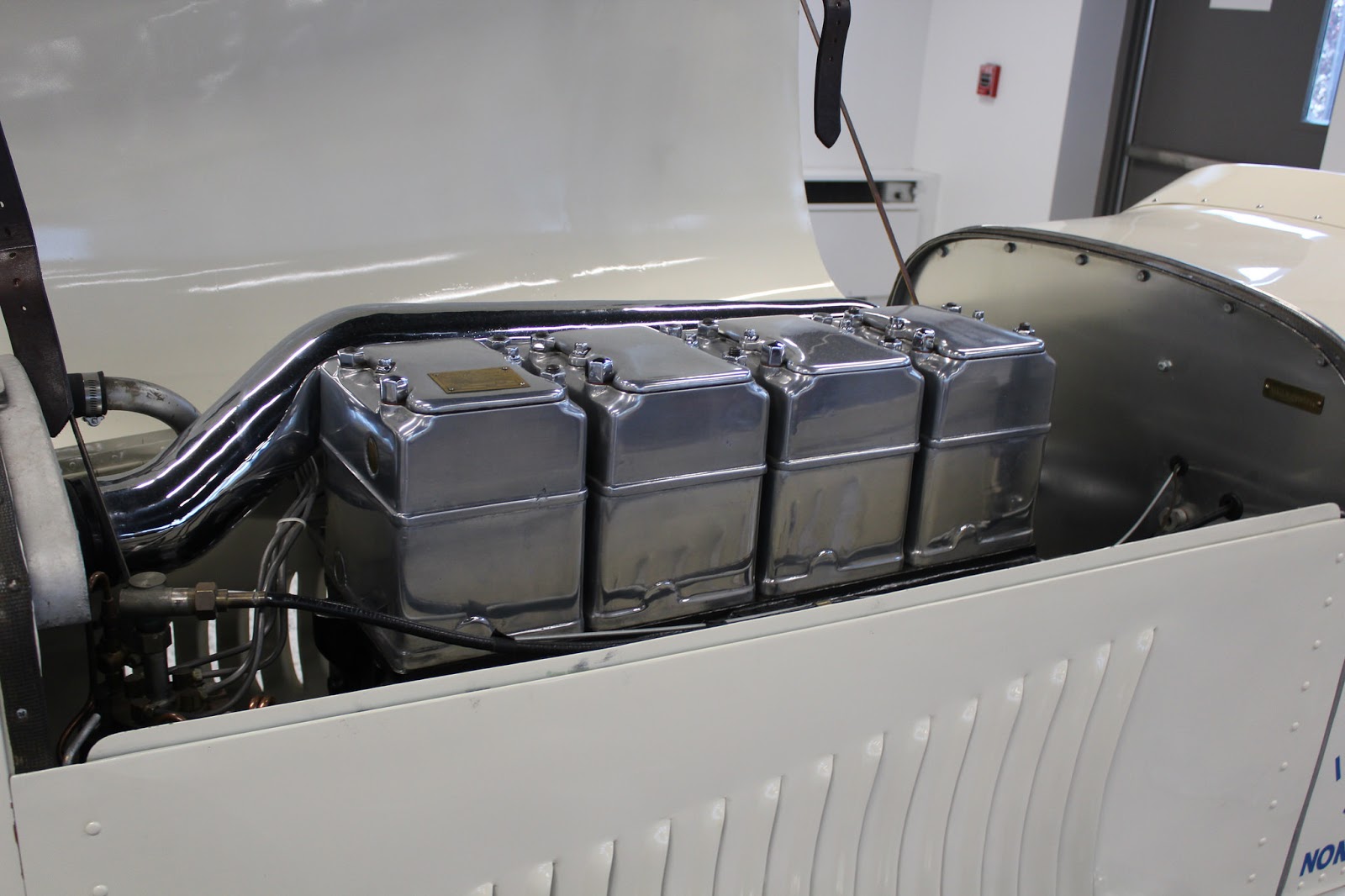
The last interesting car the display was a replica of the enchanting Cornelian racing car, which would originally have actually been built in Allegan, about 50 kms/30 miles northwest of Kalamazoo. The Cornelian was manufactured by Howard Blood, of the Blood Brothers Machine Company, which we have noted in relation to the 1903 Michigan car. It was developed in association with Louis Chevrolet, who used a Cornelian to qualify for the 1915 Indianapolis 500 race at 81 mph. The lightweight car was quite advanced for the day, boasting a monocoque chassis, an early form of rack-and-pinion steering, and independent rear suspension. At 500 kg (1,100 lbs) it is the lightest car to have raced at the Indy 500, although valve failure ended Chevrolet's race in the 77th lap that year. However, the 20th place finish was sufficient to gain some publicity for the car and Blood built a series (variously estimated at at 20 or 100) although none has survived. The example at the Gilmore Museum was on loan from the Speedway Motors Museum of Lincoln, Nebraska. The replica was built by a Michigan resident after exhaustive archival research and using some original parts.
Incidentally, cornelian (also called "carnelian") is a semi-precious gemstone that can be blood red in colour...as in Blood Brothers...
Continue to Part 2 of the Gilmore Car Museum visit here.