(PART I CAN BE FOUND HERE)
If the Small Craft Building featured the more modest watercraft, the boathouse housing the in-water fleet, the McNally Yacht House certainly delivered the fancy stuff. Outside the building was a boat used for ferrying people around the various islands and to their cottages, "That's Her." 40 feet long and built in Clayton in 1933 (on the site where the museum currently stands), she was in service until 1989 as the ferry service dwindled as more people had their own boats and put into storage. Restored by a member of the family that bought the boat in 1945, she was relaunched in 2012 and spends summers at the museum as an example of a regionally designed, built and operated boat.
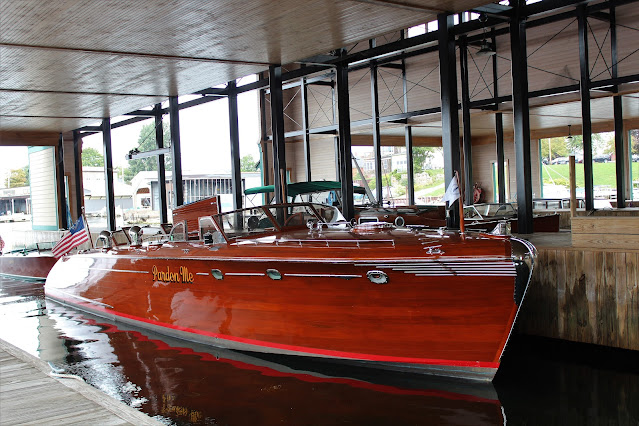
Moving into the Yacht House, one comes across what must be the crown jewel of the museum: a triple cockpit "runabout" built in 1948 by the Hutchinson Boat Works in Alexandria Bay for wealthy sportsman Charles P. Lyon to plans by legendary designer John Hacker. Built of Honduran mahogany and beautifully proportioned, Pardon Me appears to be a very large speedboat but in fact under the foredeck there is a galley, head and sleeping accommodations for four.

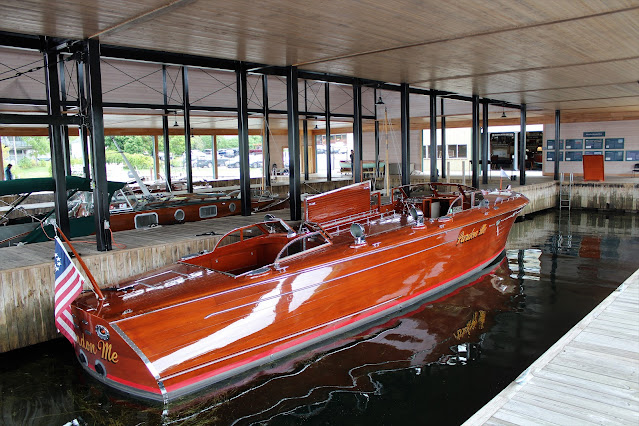
Lyon was unhappy with progress on the boat and had Hutchinson put it up for sale very soon after it was built as there were mechanical issues to be resolved. It was difficult to handle in close quarters due to its massive engine's power and Lyon only used it half a dozen times. The second owner, who purchased it in 1950, kept the boat for more than two decades, selling it in 1976. It underwent a first overhaul, including a new engine and cooling system, under the next owner. Then two of the museum's founders bought it in 1986 for donation to the museum and it underwent restoration in the museum's workshop and at a yard in Maine.
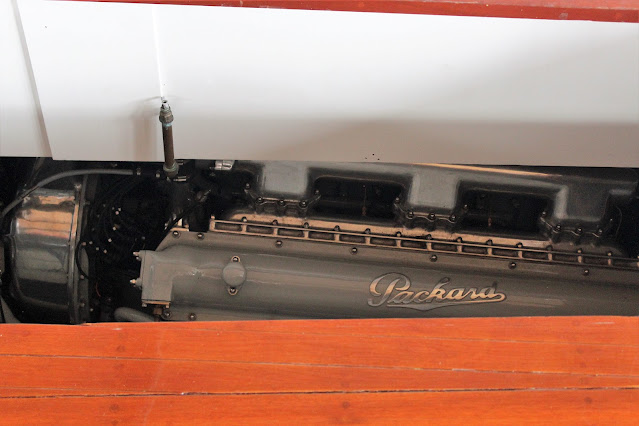 |
| Packard 4M 2500 engine |
Pardon Me is powered by a massive 12 cylinder supercharged Packard 4M 2500 engine, the same type that was used on the famous PT (patrol torpedo) boats operated by the US Navy in World War II. It puts out 1500 hp and is capable of pushing the boat at speeds of up to 60 mph, while burning high-octane fuel at the rate of 100 gallons per hour.
Pardon Me was an extravagant throwback to the 1930s speedboat era as by the time of its construction the demand for custom boats had been replaced by the availability of factory models.
At a somewhat more modest scale but still a throwback as well, the next boat on display was Miss Thousand Islands III, a 30 foot long mahogany Hacker runabout which was actually built in 2005. Since 1959, rights to the Hacker name and designs have passed through four owners, with the current company based in Queensbury, New York, just south of Lake George. This example of a fine Thousand Islands runabout is powered by a 385 hp Mercury 8.1 l engine and was donated to the museum in 2020 after 15 years of service.


An example of a Thousand Islands commuter boat, Zipper has an interesting history in that it was commissioned by John Stroh, of Stroh Brewery fame, in the early 1930s and while a respected naval architect, Ned Purdy, designed it, construction was delayed for four decades! Purdy's boatyard was gone by then but the Stroh family commissioned Staudacher Yachts to construct it in 1974. Using the original plans but modified by utilizing modern construction methods, the boat is built with a double-planked mahogany hull over steam-bent oak frames. Donated to the museum by the Strohs and serving as the flagship of the museum's in-water fleet, it has been used for cruises for major patrons of the museum. Zipper is powered by twin 454 cu. in Mercruiser V-8 marine engines and is 41'6" in length.

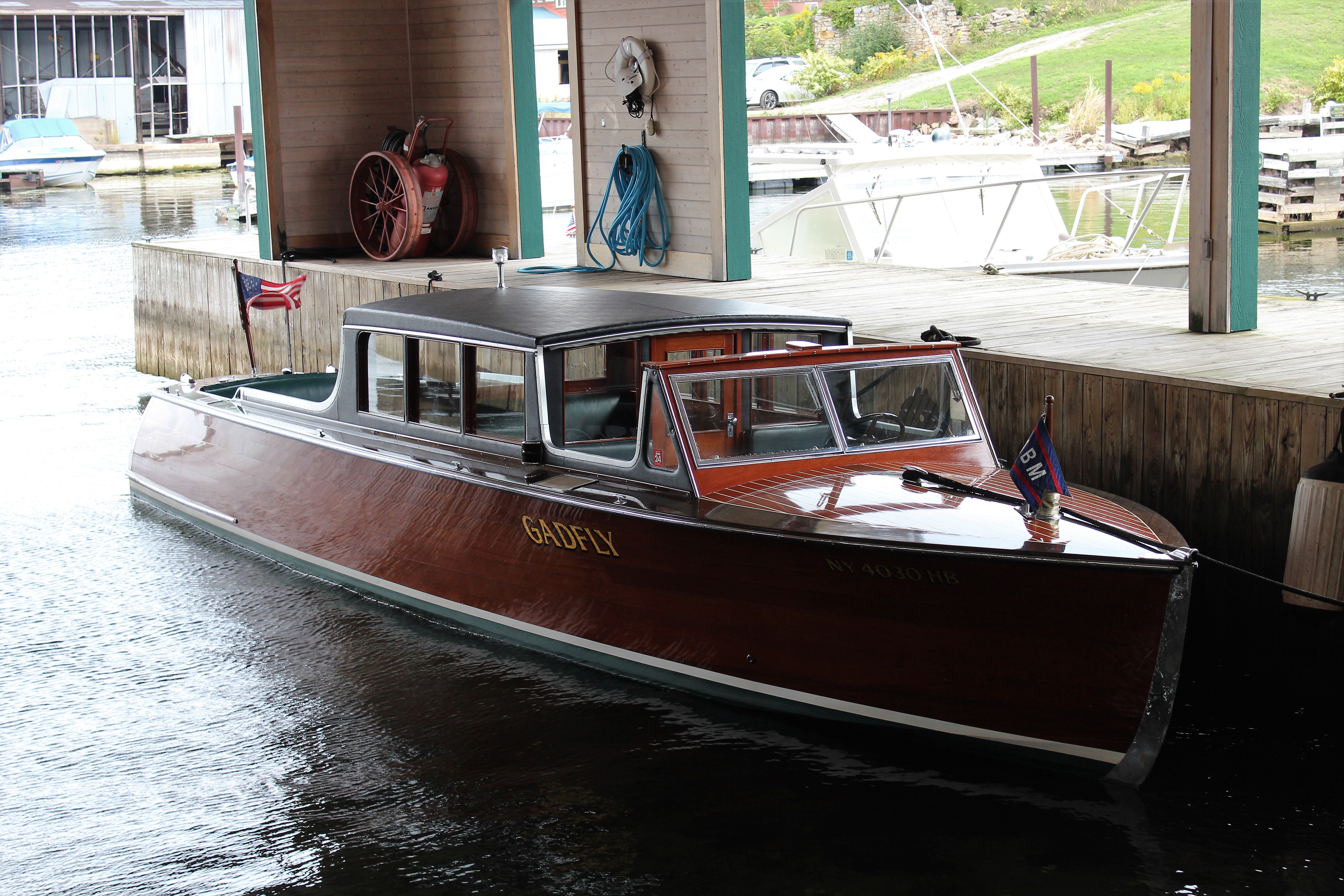
Another example of a commuter boat is Gadfly, a 33'6" boat that was a product of the Hutchinson Boat Works in Alexandria Bay. Constructed in 1931, this "Island Commuter" was a type of craft meant to be a safe and reliable (and stylish!) way to carry people and goods to the camps and homes on the islands. After being operated in the Thousand Islands region, Gadfly went to Michigan, returning to the St. Lawrence in 1994 as a donation to the museum. Fast and comfortable, Gadfly underwent a 3,500 hour restoration in 2013-2014 and is reserved for major patrons.


Available for cruises for the general public is another classic-style three cockpit mahogany runabout, the 28 foot long Teal. Gar Wood Custom Boats, owned by the Turcotte brothers of Brant Lake, NY, are among the finest craftsmen now building mahogany runabouts to traditional designs, in their case by the legendary Gar Wood. Their faithful reproductions utilize the original lines enhanced by wood-epoxy construction techniques and modern power plants. Teal, constructed in 1989, is designed after Gar Wood’s 1938 triple-cockpit runabout and is powered by a 1994 GMC 454 OMC Marine Conversion engine.
 |
| Teal (left) and Zipper (right) |

The last boat on the water in the Yacht House was Flat Top, a 29 foot long Chris-Craft which was owned by country music singing star Alan Jackson. Chris-Craft began in 1874 in Michigan when teenaged boat builder Christopher Columbus Smith started making boats for friends. The business grew and was noted for its sleek, finely-crafted and expensive speedboats. In the 1920s the company became one of the first mass-market producers of pleasure boats and reached the zenith of its reputation in the 1950s. Sold by the Smith family in 1960, Chris-Craft Corporation went through various owners until acquired by the Winnebago Corporation in 2018.
Flat Top is one of only 36 similar boats produced by the company in 1955 and the only one in restored condition. Restoration work was undertaken by the Hickman Wooden Boat Works in Tennessee. Originally delivered to a customer on Lake Chautauqua, NY, it remained there until acquired by Alan Jackson in 2002. It is named for the most popular type of steel-stringed acoustic guitars. It was donated to the museum by Jackson in 2013.
Leaving the Yacht House, the next structure on the museum campus is the Dodge Launch Building. The exhibition is designed to look like a big boat show of the past. This offers up speedboats, launches and boats with unusual powerplants but is dominated by two large Elco cabin cruisers. The boats appeared to cover a range from around 1900 to the 1950s.
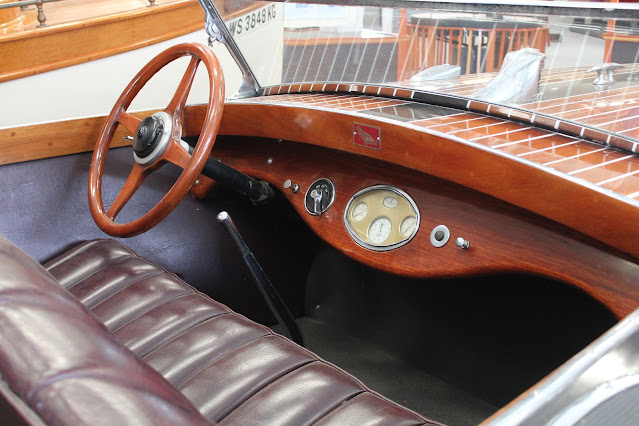 |
| 1929 Sea-Lyon 35 |
The first boat one comes across (and we are looking over the bow and in the cockpit in the two photos above) is a 1929 Sea-Lyon speedboat, built by Howard W. Lyon Inc. of New York City. It is powered by a Chrysler Imperial V8 engine.
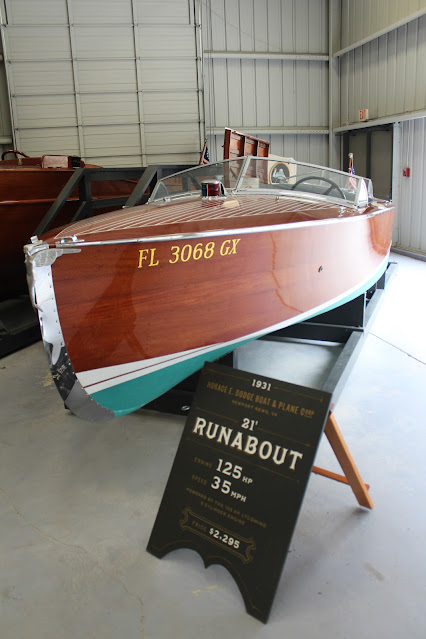 |
| This mahogany 21'6"
Runabout was produced by the Horace E. Dodge Boat & Plane
Corporation in Newport News, Virginia
|
Although
the names of John Hacker and Gar Wood are well-known in the world of
vintage wooden speedboats, in the 1930s one of the largest factories
in existence was that of the Horace E. Dodge Corporation.
Founded in 1923 by Horace E. Dodge, Jr., son of one of the brothers
who started the Dodge Brothers car company (the second largest in the
United States), Dodge was encouraged by his mother to launch his own
venture following his father's death in 1920. No expense seems
to have been spared in building a dedicated factory in Newport News,
Virginia, and while Dodge and his sister Delphine were speedboat
racing enthusiasts and had some success. The fine runabout on
display was one of four models in a lineup initiated in 1928 but the
Great Depression put an end to the demand for fabulous speedboats and
production ceased in 1935, although boats would be built in the plant
for naval patrol craft for use in World War II. The factory was
purchased by Gar Wood Industries in 1946 and stands derelict today.
Horace
Dodge (1900-1963) was a colourful character who was married five
times and lived a life of impressive opulence although he never
received his inheritance as his mother (Anna Thomson Dodge) would
outlive him by seven years. Nonetheless, he never suffered
financially, moving between four mansions in the United States,
England and France, and throwing lavish parties but eventually was
confined to a wheelchair as a result of his alcoholism. The
boats from his company are considered of the highest quality and are
much sought-after for their design as well as their rarity.


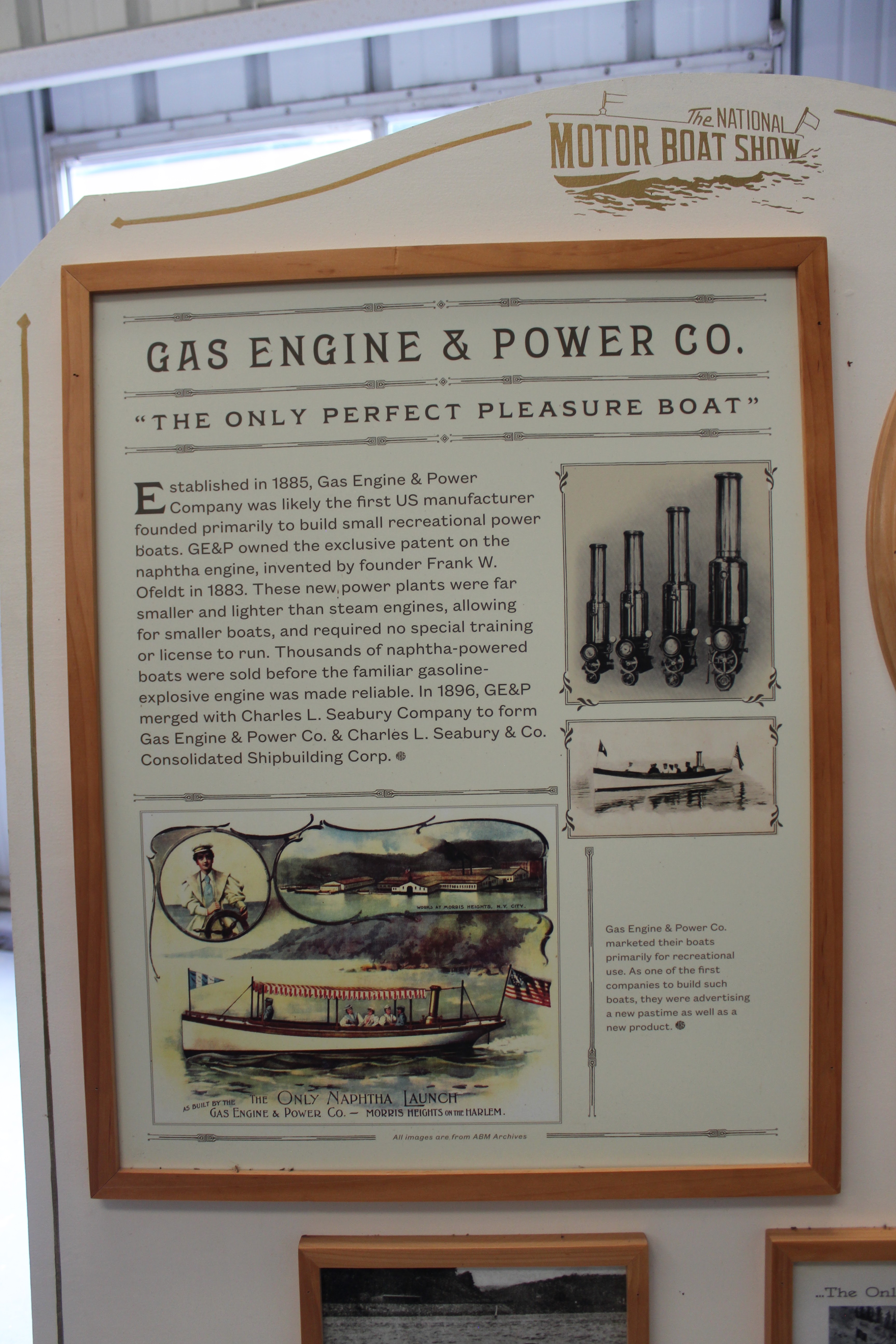
A very unusual boat on display was the 1902 Naphtha Launch built by the Gas Engine & Power Co. of New York City. Run on naphtha gas, this mode of power was a peculiarly American idea as small steam-powered launches were taken off the market as there was a legal requirement for steam-powered craft to have a qualified engineer on the crew, the result of accidents involving boiler explosions. While not a problem on large commercial craft, it was clearly not going to be practical for small private ones so this was a solution. Gas Engine & Power Co., founded in 1885, claimed to have sold more than 200 of its launches by 1900. Most vessels of this type were open boats of around 24 feet meant for pleasure cruising in nice weather. Surviving examples are extremely rare and the museum's may be one of only four remaining.
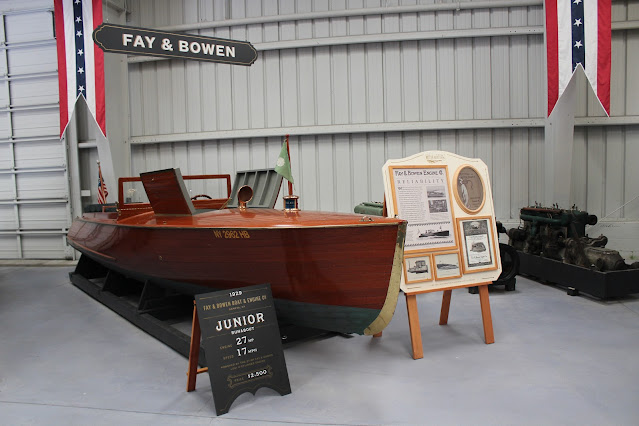 |
| 1929 Fay & Bowen Junior Runabout |
The Fay & Bowen Motorboat Factory was established in 1904 on Seneca Lake in the Finger Lakes region of New York State. It constructed marine engines, rowboats and launches and, following bankruptcy, was succeeded by the FayBow company in 1929. That firm continued in operation until 1937. The Junior Runabout, using one of the firm's own four cylinder engines, cost $2,500 in 1929 and is a very fine example of a classic mahogany speedboat.
 |
| The Fay & Bowen factory, Geneva, NY |
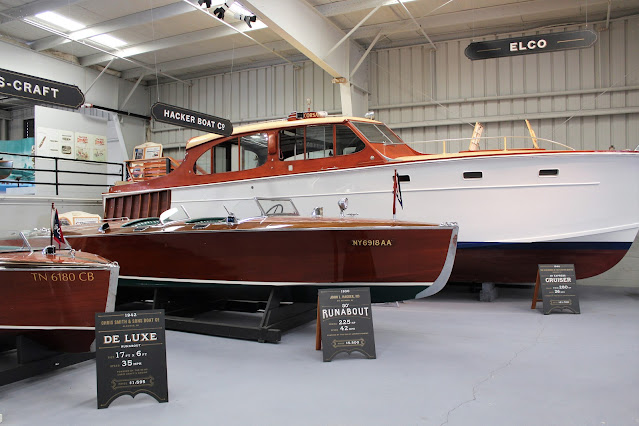 |
| Left to right: Chris-Craft Deluxe, Hacker Runabout, Elco Cruiser |
The next boat I looked at closely was a surprise. I knew that Lozier was a manufacturer of extremely high-end automobiles in the Brass Era but was unaware of their boat-building activities. In fact, after Henry A. Lozier Sr. sold his flourishing bicycle factory in Toledo, Ohio, in 1900, he relocated to Plattsburgh, NY, with some of his engineers to restart as a manufacturer of marine engines. The company's products were meticulously designed and used the finest materials. After the death of Lozier Sr. in 1903, Lozier Jr. took over the company and shared the engineers' interest in motor vehicle and production of the first Lozier cars began in 1905. Exquisitely made and outrageously expensive as the autos were, Lozier car production shifted to Detroit in 1910 but the company was out of business five years later.
The 1905 Lake Special was an open launch in which the passengers sat facing each other for a sociable cruising experience. Priced at $825, this was slightly more than the average worker's annual salary at the time in America.
 |
| Comfortable Interior of the Lozier Lake Special |
The back of the main floor of the building housed several beautiful runabouts and two sizeable cabin cruisers from Elco, a company with an interesting history..

Beginning as the Electric Launch Company in 1893, and later renamed Elco Motor Yachts, the company supplied fifty five 36 foot electric launches for use at the World's Columbian Exposition in Chicago that year. It was acquired in 1899 by one of its suppliers, the Electric Storage Battery Company (still in existence as Exide) and began production in Bayonne, New Jersey. Electric boats, which had dominated the pleasure boat market, became outmoded as piston engines improved and by 1912 the company was using diesel engines. During World War I and World War II it built various military craft, including the famous PT torpedo boats used by the US Navy. After merging with its sister company, the Electric Boat Company (maker of American submarines for over a century), it was decided to concentrate on military contracts and the yacht business closed in 1949. However, it was revived in 1987 and along with manufacturing marine electric motors, it hand crafts replicas of its classic launches in Athens, NY.
The 40 foot Express Cruiser on display was powered with twin 280 hp Chrysler engines, giving the yacht a top speed of 26 mph. Built in in 1946, it came near the end of Elco's cruiser production years. On the other hand, on the opposite side of the display was another Elco, this one from 1924. Powered by an Elco engine of 125 hp, this 42 foot long yacht was open so that visitors could walk around inside and marvel at luxury from a century ago.
Between the two big Elco boats were four elegant mahogany speedsters: a Truscott, a Hacker, a Gar Wood and a Chris-Craft. These represented a Golden Age of Runabouts, playthings for the well-healed and a delight to look at today (if maybe not to maintain!).
One is always drawn to the fabulous boats designed by John L. Hacker, who established his firm, the Hacker Boat Company, in Detroit in 1908. One already had the chance to admire two of his designers in the yacht house, Pardon Me and Miss Thousand Islands III noted above, This 30 foot triple cockpit runabout from 1930 was very fast, capable of 42 mph with its 225 hp engine, and with the onset of the Great Depression must have been a rare sight given its $5,500 price tag.


Equaling Hacker's reputation for very fast, very beautiful and very expensive boats was Gar Wood (1880-1971), a brilliant entrepreneur and inventor, as well as a speedboat enthusiast who was the first person to reach a speed of 100 mph on the water. He made his fortune by inventing a hydraulic lift system for dump trucks and was able to indulge his interest in fast boats by buying the Miss Detroit speedboat in 1916, and at the same time buying the yard where it was built, which was operated by Chris Smith, and this became the Gar Wood brand. In 1922 Smith left to start a yard using mass-production techniques and this was to become Chris-Craft. In automobile terms, if Chris-Craft was like Chevrolet and Hacker was Cadillac, then the Gar Wood boats, much-prized today, would be the Buicks. Over 10,000 Gar Wood boats were built by the time production ended in 1947 but only 300 are registered with the Gar Wood Society, which is connected to the Antique Boat Museum.


 |
| 1935 Gar Wood 16 Foot Speedster "Miss Behave" |
With the outbreak of the Great Depression, Gar Wood began to produce smaller boats that were more affordable and the resulting 16 foot runabout that was introduced in 1934 sold for under $1,000 and was quite successful. Wood's brother, Phil, took the design and converted it into a racing version, the Speedster. It had a single cockpit and a more powerful engine, along with some unusual features for a boat, such as a gas pedal and an automotive-style shift lever. Although receiving great publicity, comparatively few Speedsters were built by the time production ended in 1938.
Miss Behave has always been in the Thousand Islands region since built in 1935 and has been powered with different engines, including a Ford V8 that gave it a top speed of 60 mph. Other speedsters that came to the St. Lawrence the following year included all these wonderfully-named craft: Miss Fortune, Miss Understood, Miss Chief and Miss Conduct. All were raced in the area until the start of World War II.
 |
| "Miss Behave" next to a runabout made by the Truscott Boat Manufacturing Company of St. Joseph, Michigan |
 |
| Chris-Craft runabout |
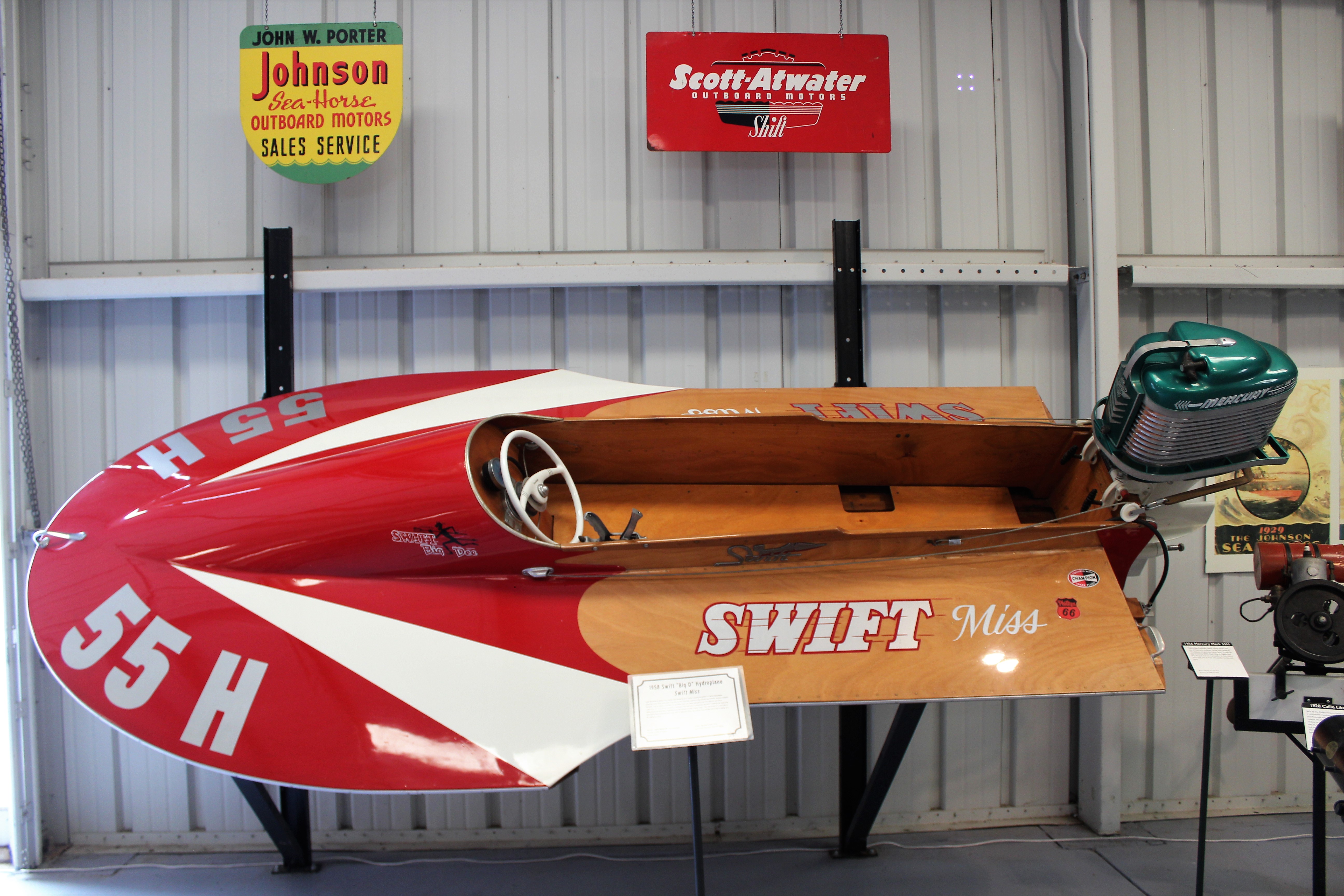
There is a mezzanine floor in the building and here there were examples of outboard motors and a sharp hydroplane, a 1958 Swift "Big D" model made by Swift Woodcraft in Mt. Dora, Florida. The company founder and chief designer was Mr. J.B. Swift, an excellent name for a speedboat manufacturer! The company built something on the order of 6,000 racing hulls between 1950 and 1958. The example in the museum, Swift Miss, is typical of the lightweight construction of these craft, with the foredeck being similar to light airplane construction, with wooden stringers and doped fabric covering. Given their construction and the aggressive nature of the racing, few hydroplanes from this period survive today.
After this tour of the Dodge Launch Building, it was time to return to the museum's main building...