Leaving the museum proper, we went outside and entered the Quonset hangars where the other static displays in the Old Rhinebeck Aerodrome collection were to be seen. Signage is fairly minimal and very homemade-looking but the basic information is provided. The arrangement of the various airplanes, engines and cars is somewhat haphazard but given the modest finances of the place not surprising. There are definitely themes: Pioneers/World War I/Golden Age. What is surprising to me is that Colen Palen's wonderful enterprise has managed to continue for nearly three decades after his passing. This speaks highly of the dedication of the volunteers and craftsmen who keep the old birds flying.
 |
from left: 1896 Chanute Glider; 1909 Demoiselle; 1911 Wright EX "Vin Fiz"; 1902 Wright Glider
in the air: background 1912 Thomas Pusher Model E, foreground modern Demoiselle XX replica |
 |
| 1909 Demoiselle (Reproduction) |
Conceived by aviation pioneer and bon vivant Alberto Santos-Dumont, the Demoiselle was his 20th design and the only one to see production in numbers. It was tiny and fragile with the airframe being constructed of bamboo but capable of surprising performance (with a light pilot). The empty weight of the airplane was 110 kg/242 lbs. Santos-Dumont was so enthusiastic about its potential he offered plans at no cost and it saw a resurgence in interest during the Ultra-Light movement in the 1980s. The example here was built by Cole Palen in the 1950s and restored in the mid-1990s, when a 30 hp Detroit Aero engine, similar to that installed in US-built originals, was installed. Lateral control is by wing-warping.
 |
| 1910 Shorts S-29 |
This is a reproduction of an airplane built by Short Brothers in Belfast, Ireland, and based on the design of the Farman III. Four examples were built and numbered S-27 through S-30. The original S-29 was a reserve airframe built for pilot Cecil Grace, who also owned S-27. The S-29 was outfitted with extended wings and other modifications but was lost over the English Channel on December 22, 1910, when Grace attempted to win the Baron de Forest Prize for the longest flight from England to Continental Europe. The Rhinebeck reproduction, built in 1971, is powered by a 60 hp E.N.V. engine as was the original.
 |
| 1903 Wright Flyer (Reproduction) |
 |
| 1911 Wright EX "Vin Fiz Flyer" |
In addition to reproductions of the 1902 Wright Glider and the famous Flyer of 1903, the Old Rhinebeck Aerodrome has an excellent reproduction of the 1911 Wright EX that colourful aviator Cal Rodgers flew in pursuit of the Hearst Prize for the first aircraft flight across the United States. Sponsored by the Amour meatpacking company that wanted to promote its new grape-flavoured soft drink, Vin Fiz, Rodgers departed from Sheepshead Bay, Brookly, on September 7, 1911, accompanied by a private three car train with sleeping quarters and spare parts. He certainly needed the parts as the EX that arrived 49 days later in Pasadena was not the airplane that had set out from New York, having gone through $18,000 in repairs. Of the 70 landings Rodgers made on the trip, 15 involved crashes and he did not win the Hearst Prize as his trip took more than the 30 days specified. Nonetheless, the jovial Rodgers made history with his omnipresent cigars and humour.
Rodgers must have been one of the unluckiest aviators in history. Not content with making it to Pasadena, he felt he had to land on the beach to say he had reached the Pacific. The nine mile flight ended in yet another crash, the only one which required him to be hospitalized. With the EX rebuilt yet again and Rodgers on crutches, the flight was finally accomplished two weeks later. Sadly, four months later Cal Rodgers crashed fatally at Long Beach as he avoided a flock of seagulls.
 |
| World War I Hangar |
 |
| 1915 Fokker E.III Eindecker |
The Fokker E-series was the company's first successful fighter design although it was an imitation of the contemporary Morane-Saulnier H shoulder-wing monoplane. What was unique was the inclusion of machine guns with synchronization, making the E-series greatly feared on Western Front. The "Fokker Scourge" lasted from July 1915 until early 1916, when the Allies were able to develop their own equivalent armament.
 |
| 1917 Fokker Dr.1 Triplane (Reproduction) |
This reproduction of the famous Fokker Triplane was built with an authentic Oberursel-type rotary engine of 110 hp. Flown in exhibitions, it is now relegated to static display.
 |
| 1918 Siemens Schuckert D.III |
Built as a fast-climbing interceptor, the Siemens Schucker D.III used the new Siemens-Halske 160 hp rotary engine. It was operational with the German air force in April/May 1918 and was received with enthusiasm for its speed and maneuverability However, a few months later overheating issues caused the withdrawal of the airplanes, which were eventually replaced by the D.IV. Among the noted pilots to have flown the D.III was Ernst Udet. The reproduction D.III at Rhinebeck uses a conventional radial engine as no correct Siemens-Halske could be found and has never been flown but used for static display only.
 |
| 1917 Sopwith Camel |
The legendary Sopwith Camel was credited with the most number of aerial victories in World War I. Introduced on the Western Front in June 1917, nearly 5,500 were built. It is considered a demanding airplane to fly due to the toque of its 160 hp rotary engine but was successful in the hands of skilled pilots including William Barker and Billy Bishop. It was used in a variety of roles, including ground attack and naval operations from aircraft carriers. This reproduction was built in 1990.
 |
| 1914 Morane-Saulnier N |
Nicknamed "the Bullet," the Morane-Saulnier N entered service in April 1915 and was operated by French, British and Russian forces in small numbers. Tricky to fly due to sensitive pitch and yaw controls due to an all-flying tail, lateral control through wing-warping rather than ailerons, and a high landing speed for the period, it was soon overtaken by the rapid progress of aviation technology and rendered obsolete after 49 examples had been constructed. It was one of the first aircraft to carry a machine gun as armament.
 |
| 1917 Albree Pigeon Fraser Pursuit |
Winner of the US Government's first contract for a pursuit (fighter) aircraft, George Albree of Boston designed this airplane and apparently three prototypes were constructed by the Pigeon Hollow Spar Company in Boston. One was used for static testing and destroyed, while another crashed, killing its pilot. The third airplane, here on display, was not completed but put into storage when the contract was cancelled. The airplane was deemed too slow and unreliable and old-fashioned. It featured a flat-bottomed airfoil and the fuselage is hinged at the tail to provide pitch control. The sign in front of the Albree Pigeon Fraser suggested it was an example of a unsuccessful airplane, something of an understatement when considers the state of aviation technology in Europe in 1917.

Aviation had made great leaps in technology in only a short time since the Wright Brothers first flew at Kitty Hawk in 1903. Flying moved into a new era, the so-called "Golden Age," with dependable engines, attractive streamline design and new ideas, such as stressed duraluminum skins. Airlines were a new industry and new navigational aids were invented. Cities could not claim to be modern and progressive without a fine new airport. Air racing and aerobatic shows attracted thousands.
 |
Golden Age Hangar (1919-1940)
clockwise: Morane-Saulnier MS130; Waco 10; Spartan C3; Aeromarine AKL-26; Aeronca C3; Bird Model CK; Nicholas Beazley NB-8G. suspended in foreground: Dickson Primary Glider; in background: Heath Parasol LNA-40 |
 |
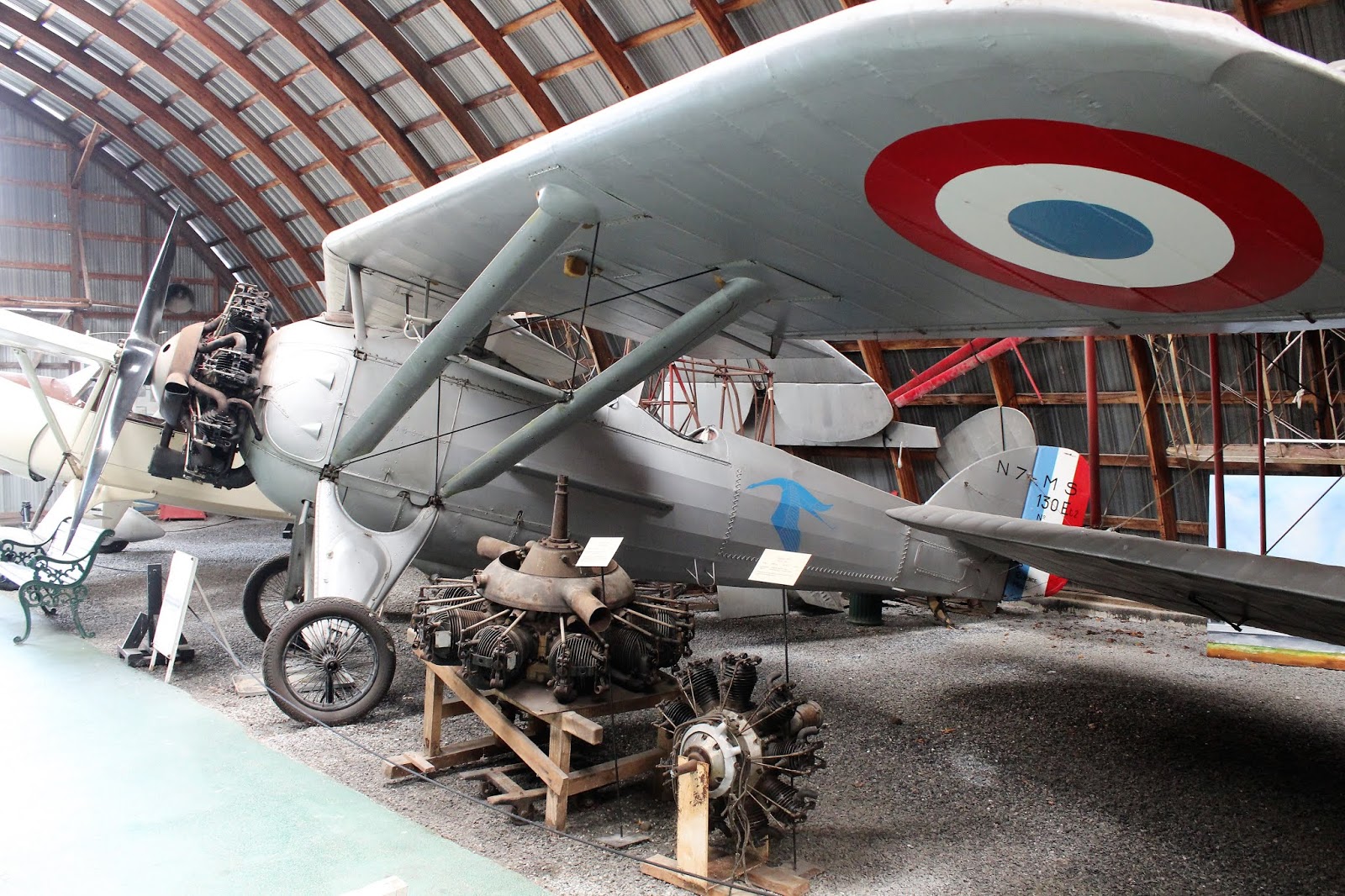
| 1927 Morane-Saulner MS130 |
Designed as an advanced trainer, reconnaissance plane and postal aircraft, the two-seat tandem MS130 was used primarily by the French Navy (146 built) but also found service with several foreign air forces. Powered by a Salmson 9AB engine of 230 hp, it was introduced in 1925 and became a favourite of French aerobatic pilots. A modified MS130 piloted by famed aviator Michel Detroyat won the 1929 Coupe Michelin competition, covering 2,788 kms at an average speed of 190.2 km/h. The course required landing at more than a dozen French cities en route. Detroyat would win the Thompson Trophy and Greve Trophy races at the National Air Races in Los Angeles in 1936 flying a Caudron C.460.
 |
| 1927 Waco 10 |
Produced by the Advance Aircraft Company of Troy, Ohio (later to be renamed the Weaver Aircraft Company in 1928/29), the Waco 10 utilized surplus Curtiss OX-5 engines to produce an inexpensive three seat airplane that was popular for barnstorming, as well as pilot training and by small operators for charter flights. From 1927 until 1933 more than 1,600 were produced with various engines besides the 90 hp OX-5 in the Rhinebeck example.
 |
| 1929 Spartan C3 |
The Spartan Aircraft Company began production of the C3 in 1928, using a variety of engines. The airplane was conventional in design made of steel tubing, wood, and fabric. It had a three passenger cockpit and was primarily for flight instruction, as well as barnstorming. The factory price of this airplane in 1929 was $6,750. It used a 165 hp Wright J-6 radial engine. 122 were manufactured, of which three exist today.
 |
| 1929 Aeromarine AKL-26 |
Hans Klemm may be considered the inventor of the light sports airplane with his designs, the first of which were built in conjunction with Daimler. When that company left the airplane business, Klemm set up on his own and the result was the successful KL-25 type, with around 600 built in Germany between 1929 and 1936 in 30 different variants. License production was undertaken in Britain and the United States, where this example, the AKL-26 variant, was built by Aeromarine-Klemm. Aeromarine operated with some independence from the German company and was to build 122 of these excellent aircraft. It was outstanding for its ease in handling and slow flight characteristics.

The Klemm is of all wood construction with a cantilever wing and was designed to be disassembled in minutes. Klemms could often be seen being towed behind cars and stored in garages. The AKL-26 was powered by a 65 hp LeBlond but some Klemms flew with as little as 20 hp, far less than the era's typical biplanes. American buyers demanded more power and some Aeromarine-Klemms utilized the 85 hp LeBlond, but performance in all versions was remarkable, with some aircraft even being operated on floats.
The Aerodrome's AKL-26 was flown only once at the Aerodrome before being put on static display. It is one of only two known AKL-26s extant.
 |
| 1931 Bird Model CK |
Built in 1931 in Brooklyn, New York, by the Bird Aircraft Corporation (formerly Brunner-Winkle), this airplane was designed for barnstorming/joyriding, with room for three passengers and the pilot. It was the third generation Bird biplane and was powered by a 125 hp Kinner B-5 radial. The upper wing is twice the area of the lower one, offering lower wing-loading than its competitors. This airplane was used for joyriding at the Aerodrome for many years and is one of 50 built.
 |
| 1931 Nicholas Beazely NB-8G |
The Nicolas Beazely Company of Marshall, Missouri, was established as an aircraft parts supply house in 1921 and eventually went into aircraft manufacturing. The NB-8G was a fully aerobatic, two seat parasol-wing light aircraft powered by an Armstrong-Siddeley Genet Mk II engine of 80 hp. 57 were manufactured between 1931 and 1935; six are still extant.
The Aerodrome example was purchased by restorers in Elmira, New York as a basket case in 1958 after it had sat in storage for 22 years. It was flying again by 1964 and was donated to the EAA Museum in Oshkosh, Wisconsin. It was subsequently purchased at auction by Cole Palen in 1982.
 |
| 1937 Fairchild 24H |
One of the classics of the Golden Age, the Fairchild 24 was an elegant four seat high-wing monoplane launched for the private market in 1932 and was produced until 1948. It was adopted by the United States Army Air Corps and the Royal Air Force for light transport duties. The 24, with either Fairchild Ranger inline or Warner Scarab radial engines, was built by the Kreider-Reisner Division of Fairchild Industries in Hagerstown, Maryland and when production ended 2,232 had been built. This included postwar production by TEMCO in Dallas of 280.
The Aerodrome airplane is one of 25 built as a 24H variant, using a 150 hp Ranger engine. 1937 Fairchild 24 interiors were refreshed by noted industrial designer Raymond Loewy and are quite luxurious, even offering roll-down windows. Cost of the 24H, which was only built in 1937, was $5,590.
 |
| left: 1931 Rolls-Royce; right: 1931 Austin 7 |
On to Part 4--The World War I Dogfight Spectacular--
here.