Showing posts with label travel in America. Show all posts

Thursday, July 27, 2017

The Sport of Kings: Horse Racing at Saratoga Race Course--July 26-27, 2017


We had been to Saratoga Springs for the Hemmings Concours d'Elegance (an event subsequently moved to Lake George) and had enjoyed the ambiance and decided to return for the horse racing.


Standardbred horse racing took place in Saratoga as early as 1847 but the current track for thoroughbreds started operations in 1863, making it among the oldest sporting venues in the United States.  The racing season is 40 days long, ending on Labour Day, and the most noteworthy event is the Travers Stakes, the oldest major thoroughbred horse race in the USA, inaugurated in 1864.  In 2015 the presence of Triple Crown winner American Pharoah saw the purse increased to $1.6 million but the Saratoga track once again earned its nicknames of "The House of Upsets" and "The Graveyard of Champions" as the heavily favoured Pharoah came second.  In the 1919 Sanford Stakes, the legendary Man o' War lost his only race in 21 contests.


The track has had its ups and downs and was deteriorating by the end of the 1800s.  In 1896 there was no season due to increased competition from other tracks and it was only in 1901, when a group headed by William C. Whitney bought the track that improvements were made and its reputation restored.  Anti-gambling laws meant closure for two years in 1911 and 1912, but the track has operated continually since.


There are three separate tracks at Saratoga: an outer, dirt track of 1 1/8 miles in circumference; a 1 mile inner turf track, and a shorter inner track used for steeplechase racing.  Races in the season are held six days a week.


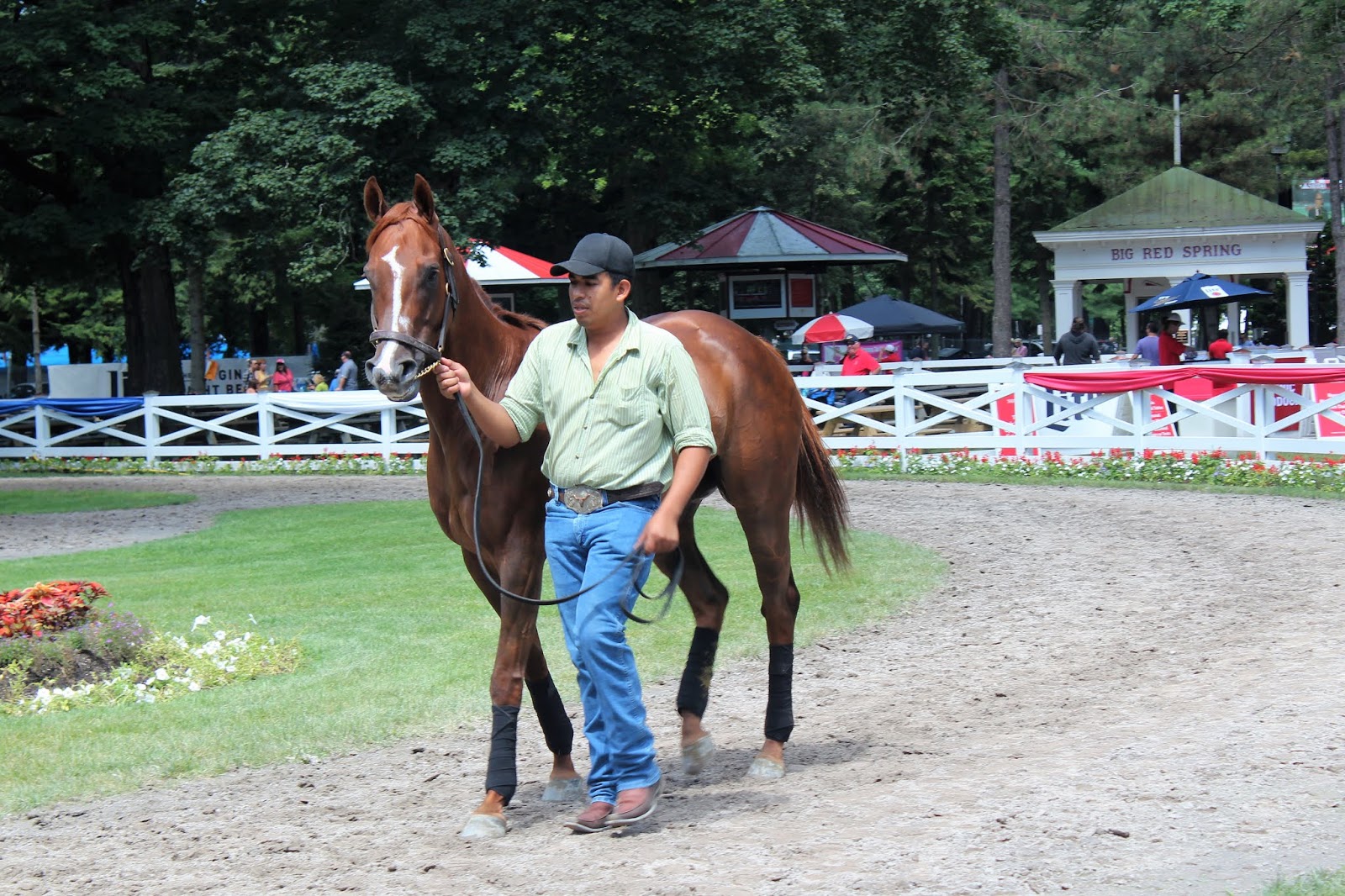
We spent two days at the track, watching the races and took a walking tour of the facilities.  It was a very pleasant experience but we felt no particular compulsion to make any bets.  It was clear that there is no way to systematically play a horse race, unlike a casino game.  For example, at one point the main track was too wet so the horses were switched to the inner turf track, which would mean that the odds for the horses, which had been calculated based on their running on a dirt track, were now pretty meaningless.  Given Saratoga's traditional cruelty to race favourites, it seems like throwing money away.


On the other hand, there was a lot to look at, from some entertainers singing some 1940s big band songs, to watching the horses being exercised, to enjoying a wood-fired pizza.  There are some displays related to racing history, and you can get a look at the area where all the racing silks are stored.  It is a good place for women to buy fancy hats too.


A short walk away from the Race Course is the National Museum of Racing and the Racing Hall of Fame.  Established in Saratoga Springs in 1951, it moved to its current location in 1955.  The Hall of Fame is the main emphasis, highlighting horses, jockeys, trainers, and owners, but there are fine exhibits about the history of horse racing in America.  When we were there a special exhibit on the life and times of Man o' War was on display.

Walking up the museum, you will see a long line of jockey figures.  Each is dressed in the colours of a particular stable that has horses racing at the track.


Tuesday, September 29, 2015

A Tour of Winterthur, Delaware, September 29, 2015


After our overnight stay at a B&B in Kennett Square, Pennsylvania, a short drive took us the Winterthur Museum, where we had been twice before but some twenty-five years ago. 

The museum is quite remarkable: situated on nearly 1,000 acres of prime real estate not far from Wilmington, Delaware, Winterthur was the home of three generations of du Ponts but it was when it came into the possession of the last of these, Henry Francis du Pont.  A collector of European antiques and decorative arts, he changed the direction of his acquisitions to focus more on Americana and expanded the house he inherited some sixfold--from 30 rooms to 175-- to house his collection.  His other passions were Friesian cattle, of which he became one of the preeminent breeders in the United States, and horticulture.

The main house, with 96,500 square feet of space
The collection consists not just of objects, numbering around 89,000, and which began with the purchase in 1923 of a 1737 Pennsylvania Dutch chest, on display near where the tours of the museum begin.  It includes not only ceramics, furniture, glass, metalwork, paintings, textiles and needlework, but architectural features as the du Ponts begain to collect entire rooms from houses being demolished.  Hence the massive growth of their house as it was expanded in 1928-1930, reaching seven stories in some sections.  In 1951, the du Ponts moved to a smaller house across from the main one and the Winterthur Museum was born.

This room features decorative Chinese wallpaper from 1775-1800


Georgian silver tea service

Another view of the Chinese wallpaper room

A slightly less historic room: this is where the du Ponts lived until they moved out of the house in 1951 as it was turned into a museum of decorative arts
Particularly beautiful  is the Montrmorenci staircase (heading photo), removed from a plantation house in North Carolina that was demolished in 1935, with its mantels, moldings, cornices and this staircase being saved.  The staircase, which dates from around 1840, was modified to fit Winterthur and from a circular shape became elliptical.  And one of the strongest images one takes away from the museum.

Another view of the Montmorenci staircase
As wonderful as the Winterthur Museum was, we had the definite feeling of being hustled from room to room by the tour guide somewhat faster than we would have liked.  Each room is filled with interesting pieces and it is clear that the du Ponts not only had unlimited funds but superb taste.  H.F> du Pont was called in by Jacqueline Kennedy when the White House was remodeled to add his historical interior design perspective.

Since our last visit to Winterthur, some new galleries were added that feature special exhibitions.  At the time of this visit, there was a marvellous collection of Tiffany glass pieces, including not only the famous lamps but also a number of the gorgeous stained glass windows, and fascinating insights into the extensive workshop of Louis Comfort Tiffany and profiles of his talented staff.


The second gallery was devoted to an exhibition of pieces of Pennsylvania German origin, sturdy but charming.  In addition, there were two complete workshops that had been reconstructed in situ, the one where wooden clocks were manufactured, and the other a woodworking shop, run by three generations of the Dominy family of East Hampton, Long Island, New York, from 1745 onwards.  This remarkable collection of early American tools had been assembled by du Pont's team and placed in replica structure inside the museum in 1960.

A chest decorated for Johannes Miller in 1783, believe to have been done by Heinrich Otto.  The flowers are typical motifs of the style but the camels are highly unusual.


The Dominy clock shop reconstruction

Dominy clock workshop interior


The Dominy house, shortly before its demolition in 1946.  The workshops were attached as wings to the house.

Immediately after our visit, there was an article in a Long Island newspaper about repatriating the clock shop and woodworking shop back to East Hampton but as far as I know they remain at Winterthur.

And you will want tor remain at Winterthur as well.  In addition to the museum, there are extensive and very beautiful gardens to enjoy.  Highly recommended!