Showing posts with label Brass Era cars. Show all posts

Saturday, August 19, 2017

Northeast Classic Car Museum, Norwich, New York, Part 1--August 19, 2017


At one time travelling down I-81 we pulled off at a rest stop for a brief break and while browsing the brochures of attractions in New York State one caught my eye as it was promoting the Northeast Classic Car Museum, which was unknown to me.  Keeping the brochure we determined to visit the museum when an opportunity presented itself.

That came when we spent a weekend in Cooperstown, New York, to attend performances at the Glimmerglass Opera.  As one of the shows was not until the evening, we had the day free and set off for Norwich, New York, and the museum.  This took a surprising amount of time--Cooperstown is somewhat isolated in its own right and the roads to Norwich as we headed west were all little country roads so it took us nearly an hour to drive the 62 kms but it was a pleasant trip.

Norwich is a very small town (pop. 7,900) and we found the museum quickly.  It is housed in a rather modest-looking building but that was misleading as what you see from the parking lot is only one-third of the actual structure.  


1957 Ford Fairlane 500 Skyliner
Entering the museum (and momentarily ignoring the gift shop!), the first car to be seen was a beautiful 1957 Ford Skyliner, one of 20,766 built that year which marked the introduction of the world's only hardtop convertible.  All Skyliners were powered by V8s and this one was the optionalThunderbird V8 of 312 cu.in,  producing 245 hp, which cost $43 more than the standard 292 cu.in. motor.  This particular example, built in California, received a frame-off rotisserie restoration in 2006 and has won numerous awards.  It has only 20,800 miles and options included a three-speed automatic transmission with overdrive ($108), power windows ($70) and signal-seeking radio ($100).  The top is very complex, with 600 feet of wiring, 8 servo motors and 20 contact switches.  The Skyliner, introduced in the middle of the model year, was priced at $2,942.

This car had a special attraction as the first family car I can recall was our 1957 Ford Ranch Wagon, which shared the same Inca Gold and Wimbledon White two-tone paint scheme, with the gold anodized trim along the sides.  However, our car--the first new one purchased in our family--would have been pretty basic, with a three-speed manual transmission and no radio.  These two door station wagons have become very rare now; certainly ours, used for business, was pretty much finished by the time it was replaced with a Chevrolet Impala Coupe in 1966.


1912 Metz Roadster
The marvellous Metz, built in Waltham, Massachusetts, from 1909 to 1922, had a most unusual history.  Started by Charles Herman Metz, who began as a bicycle racer and then went on to be the manufacturer of Orient bicycles, he expanded in 1901 to begin production of cars but had a falling-out with his partners and left the firm.  He returned as the rescuer of the company in 1909 and confronted with large debts but a lot of spare parts he instituted a build-it-yourself program that allowed consumers to buy their Metz car in fourteen packages for $25 each and do the assembly themselves.  The Metz, available only as a stylish roadster, was a simple vehicle and noteworthy for its friction transmission, which made gears unnecessary and was an ancestor of today's CVT.  The Metz Plan was successful and the Roadster in the museum was an example that would have cost the buyer/builder $495, although the company also offered cars assembled in its factory for $600 starting in 1911.

The firm flourished and three Metz cars were entered in the 1913 Glidden Tour, which the team won with a perfect score, indicative of their reliability.  Metz cars were also successfully exported.  Although the company did offer cars with a conventional transmission and shaft drive in 1918, sales were insufficient and the firm ceased operations in 1922 in bankruptcy.  Mr. Metz then drove the last Metz built to California where he started a construction company with his son, passing away there in 1937.

Leaving the lobby of the museum, we entered the first section of the roughly chronological display of cars.  Having been to many automobile museums, we were very impressed by the truly obscure marques that the museum featured, an excellent education in pre-Great War motoring.  In some cases mannequins stood next to the cars dressed in appropriate period clothing. 


1909 Black 2 Passenger Runabout
The short-lived Black Manufacturing Company introduced its new highwheeler vehicle at the Iowa State Fair in 1908 and came away with $50,000 in orders.  The Black was a simple two-cylinder 18 hp air-cooled buggy with chain drive and solid rubber tires, but the company offered an even more primitive vehicle, this 14 hp two seater sold as the Chicago Motor Buggy, for $450.  In 1909 the firm bought out a defunct manufacturer west of Chicago to obtain factory space and also came to a business arrangement with a company in Indiana, the Crow Motor Car Company, to produce a larger, four cylinder machine to be sold as the Black Crow. A year later Black's partner in Indian decided it could just produce the car by itself as the Crow-Elkhart and Black was out of business. 


1910 Pullman Touring Car Model K-10
This handsome car was built in York, Pennsylvania, by the Pullman Motor Company, which had begun in 1905 as the York Motor Car Company and had faced financial problems during the Panic of 1907, being then taken over by rescuers from New York.  The Pullmans had a reputation as a quality car and this example, which cost $2,000 in 1910, had a 35 hp four cylinder engine, three speed transmission and separate dual ignitions, one for the battery and the other for the magneto.  The folding top and windshield were a $150 option.

Sales success led to the company's downfall as the rush to production meant lower quality.  The New York financial people were succeeded by local York businessmen in 1915 but to no avail as the firm went bankrupt in December 1916, with the last Pullmans leaving the factory as 1917 models. 


1914 Detroit Electric
The Anderson Electric Car Company of Detroit produced Detroit Electric cars from 1907 to 1937, building (and rebuilding) some 13,000 electrics in that time.  This Model 48 Brougham was one of 4,669 cars the firm built in 1914 and was priced at $3,000, their most expensive model.  With a range advertised as 80 miles between charges it was marketed as an urban vehicle.  Its prime attractions were lack of noise, no gears to shift, and ease in starting but after the introduction of electric starter in gasoline cars beginning in 1912 the electric car fought a rearguard action.  Later models of Detroit Electric took on the appearance of gasoline-powered cars, including fake radiator shells, but it would take the introduction of lithium-ion batteries to make electrics viable again when Tesla introduced its Roadster in 2008.


1910 Waverly Electric 4 Passenger Brougham
Not as well known as the Detroit Electric, the Waverly was produced by a company that had begun in 1898 as an element of Albert Pope's automotive empire, operating under different names until purchased by a group of Indianapolis business after Pope-Waverly, as it then was, went into receivership in 1908.  The Model 75 Brougham, on a 79 inch wheelbase, sold for $2,250.  While the company never made money under Pope auspices, the new managers apparently had some success but unable to compete with the more practical gasoline cars the company faded away by 1916.

1912 International (IHC) Truck/Runabout
International Harvester introduced its highwheeler truck in 1907 and built them until 1912.  Popular in rural areas, more than 4,500 were built.  Built in Akron, Ohio, and equipped with a two cylinder 26 hp or 30 hp engine, it was marketed as a five passenger touring car for $2,700, converted from its truck incarnation to a car through the simple addition of additional seats.


1927 Chandler Standard Six
Started in 1913 by a group of disaffected executives formerly with the Lozier Motor Company of Detroit, the new Chandler Motor Car Company of Cleveland was almost immediately a success, producing a line of highly-regarded mid-priced cars.  1927 was the firm's most successful year, with some 20,000 cars being produced.  This example, a Standard Six five passenger sedan, sold for $995.  Chandlers were noted for their success in high-climbing competitions but after an attempt to market a lower-cost companion car, the Cleveland, Chandler was eventually absorbed by the Hupp Motor Car Company in 1928 and Chandler production ceased soon afterwards.


1910 Firestone-Columbus Series 7-A Runabout
The Columbus Buggy Company of Columbus, Ohio, had introduced an electric car in 1903 and a simple $750 two cylinder highwheeler in 1907 but the latter was discontinued when this model, "The Car Complete," arrived in 1909.  It was named after the company president, Clinton Dewitt Firestone.  The 7-A Runabout was powered with a four cylinder 24/25 hp engine and cost $1,800.  Columbus Buggy went bankrupt in 1913 and Mr. Firestone died in 1914.  An attempt was made to keep the company going under new investors as the New Columbus Buggy Company but it was all over by 1915.

1914 Buick Model B-37
Founded in 1903 by David Dunbar Buick, Buick became the cornerstone of what was to become General Motors after it was acquired by Billy Durant as controlling investor in 1904.  The Buick was among the first to offer an overhead valve engine.  This five passenger touring car sold for $1,485 and 9,050 examples were produced in 1914.  It featured a 221 cu. in. inline four cylinder engine putting out 35 hp.


1909 Victor Model D Open Runabout
The Victor Automobile Manufacturing Company of St. Louis, Missouri, began production of its highwheeler model in 1905 and by 1909 was offering a choice of solid or pneumatic tires.  It was powered by a two cylinder engine of 14/20 hp and priced at $720.  The Victor became larger and more powerful by 1911 but to little avail as the firm's founder passed away that year and the firm folded.


1920 Chevrolet Series 490 Two Door Roadster
In May 19168 Billy Durant propelled himself back into the leadership of General Motors but conducting a reverse takeover using his Chevrolet Motor Car Company, established in 1911.  By 1920 he was out again but it was decided that Chevrolet would be General Motors' volume leader.  This Series 490 was introduced in 1915 at $490 to compete with the Ford Model T and was very successful to that the extent that the Chevrolet company's value soared, providing Durant with the asset he needed.  The 490 was gradually increased in price with this roadster retailing for $795.  Powered by an overhead valve inline four cylinder engine of 24 hp, the 490 was produced until 1922.  By 1929 Chevrolet had surpassed Ford in annual sales.


1924 Stanley Steamer Seven Passenger Sedan
The Stanley Brothers, identical twins who had a photographic equipment business in Massachusetts, started building steam cars in 1897 and their cars were noteworthy for high performance, with the perhaps the most publicized event being Fred Marriott's run along Dayton Beach in a streamlined racer, the Stanley Woggle-Bug, reached 127.66 mph, the World Land Speed Record of the day.  Stanley phased out motor sport participation in 1909 and soon afterward the introduction of electric starting for gasoline cars began the slow demise of the steam car business.  The Stanley car was conservative in design (and marketing--no advertising until 1915!), lacking a flash boiler and a steam condenser, which meant that the car's chief advantages of rapid acceleration and quiet operation were offset by the very lengthy time needed to start the car and then the constant stopping to take on water.  While the car was improved time was already running out for the steam car.  Stanley's primary competitor, White, had made the switch to gasoline in 1912, but Stanley soldiered on until going into receivership in 1923.  Its assets went to the Steam Vehicle Corporation of America which continued production of Stanleys until fading from the scene in 1925.  This seven passenger sedan, built on a 130 inch wheelbase, was one of only 120 built, among the last of the Stanleys.

1921 Mitchell Model F-40 Five Passenger Touring Car
The Mitchell Motor Car Company of Racine, Wisconsin, was the eventual outgrowth of the wagon works of Henry Mitchell, a firm which went on to produce bicycles before turning to autos.  Car production began in 1903, making it one of America's earliest car companies, and the firm prided itself on manufacturing almost all of its components locally.  The car was considered a quality vehicle in the mid-level market.  There was a management shake-up in 1913 and the company dropped production of four cylinder cars after 1915, concentrating on sixes thereafter (although a 29 hp V8 was also produced in 1916 only).  By 1919 annual sales had reached 10,000 units and Mitchell decided to set itself apart through styling.  The 1920 Mitchell featured a slanted windshield and, at a different angle, a radiator that was tilted backwards.  The car earned the sobriquet "Drunken Mitchell" and sales plunged.  A quick return to an upright radiator did not help and by 1923 Mitchell only produced 100 cars before it went bankrupt.  The Model F-40 in the museum would have cost $1,750.


1915 Scripps-Booth Model C Roadster
Among America's pioneers in the auto industry was the colourful James Scripps Booth, a scion of the Scripps publishing firm, who was both an accomplished artist and a passionate auto enthusiast.  Highly inventive, his first car was the Bi-Autogo, a seeming combination of a car and motorcycle that offered the first V8 engine ever made in Detroit.  Only a prototype was built (at a reported cost of $25,000) and resides today at the Detroit Historical Society.  Booth went on to start a new company, the Scripps-Booth Cyclecar Company, to manufacture the Rocket cyclecar in 1913, which sold for $385 and, as far as cyclecars went, was perhaps the fastest and most durable of the species.  However Booth recognized that that the cyclecar era would be short-lived so he started another firm, the Scripps-Booth Company, with a fresh infusion of family capital in late 1914.  This would produce what Booth called "a luxurious light car." He brought in noted engineer William B. Stout (who had designed the Imp cyclecar and would go on to design airplanes for Henry Ford as well as the Stout Scarab) and the result was the 1915 Model C, a staggered-seating three seat roadster.  Using a four cylinder overhead valve Sterling engine of 18 hp. the roadster sold for $775 and was quite innovative.  It included a horn button on the steering wheel, a handsome German silver radiator shell, shaft drive, a step-down frame, wire wheels and a torpedo rear deck.

By 1916 the company had produced 6,000 cars and the sprightly Model C had some celebrity buyers, including Reggie Vanderbilt, Mrs. Jay Gould and Winston Churchill.  In November the company had gone public and acquired the Sterling Motor Company, but reliability problems began to crop up.  Booth was unhappy with the direction the company was taking and particularly when Series 490 Chevrolet engines were substituted for the Sterling unit.  He left the company in 1917, the same year that it was absorbed by Chevrolet under Durant and subsequently became part of GM.  The car became simply another GM car and management, after Durant's departure, could not see a reason for its existence.  By the time the production ended in 1922, 60,000 Scripps-Booth cars had been built.

1921 Holmes Series 4 Seven Passenger Touring Car
The Holmes Automobile Company of Canton, Ohio, was started in 1918 by a former vice-president and chief engineer of the H.H. Franklin Company so it is not surprising that the company would be another advocate for air-cooling.  Larger and slightly more expensive than the Franklin, it claimed to be America's most comfortable car, thanks to its flexible chassis, long wheelbase an full-elliptic springs although many felt it was also America's ugliest car.  Plans were made for production of 4,000 in 1918 but never exceeded 500 each year the company was in operation.  This was not for very long--a vice-president of the company was charged with larceny and embezzlement in 1921 and by 1922 the company was in receivership.  Only four cars are known to still exist.  This touring car, priced at $3,350, used a 31 hp six cylinder engine.


1916 Studebaker Model ED-6 Limousine
In 1916 Studebaker's production was almost entirely open touring cars or roadster, with closed cars making up only 2% of output.  Of those cars, only a handful were limousines and this is the only one known to exist.  It is powered by an inline six of 354 cu. in. displacement, making 54 hp, and cost $2,250.  So few were ordered that bodies were outsourced to coachmakers Willoughby & Co. in Utica, New York..  The front bumper of this car was an option and the coach lights were aftermarket additions.


1929 Nash Model 422 Standard Cabriolet
Charles Williams Nash's story was truly a rags-to-riches one.  Abandoned by his parents at age six, he became impressively self-reliant and eventually ended up at the Durant-Dort Carriage Company in Flint, Michigan, in 1890, where he earned $1 each day stuffing upholstery.  Within six months he had become factory supervisor and within a decade vice-president of the company.  He rose with Durant and by 1910 was vice-president of Buick.  When Durant was ousted from GM, Nash became the President of General Motors and made impressive improvements in the company's operations. When Durant returned in 1916, he offered to let Nash continue as GM President but Nash wanted to be his own boss.  Striking out on his own, he bought the struggling Jeffery Motor Company in Kenosha, Wisconsin, renamed it Nash Motors in 1917 and ran the company until 1936.  

A remarkably astute businessman, Nash was able to make a great financial success of the company and maintain its independence in difficult circumstances.  Nash cars were solidly built, reliable quality vehicles meant to appeal to America's middle class.  Forays by Nash into the luxury field (LaFayette) and economy end (Ajax) were missteps that did not harm the core Nash brand.  After becoming part of American Motors in 1954, the Nash brand was dropped (along with Hudson) in 1957 as AMC went only with the Rambler name, originally used by Thomas Jeffery in 1897.  

This Nash Model 422 was the most basic of three trim levels offered by Nash.  Priced at $995, when the average 1921 car sold for $425, it was powered by a 50 hp six cylinder engine and this example features the "Royal" option package, which included six wire wheels, two side-mounted spares, a rear folding trunk rack, and a full rear bumper.


1931 Ford Model A Cabriolet
Introduced to wide acclaim as a 1928 model, the Ford Model A was designed to be a far more stylish competitor to the Chevrolet line that the Model T could be.  4.8 million were sold by the time production ended after a rather short period in 1931.  This cabriolet was a revamped body style premiered in this final production year, one of sixteen body styles offered that year, and 11.081 were built, with a listed price of $595.  Like all Model As, it had a 40 hp. 200 cu.in. inline four cylinder engine.  A Ford Model B was to arrive in 1932 with 20% more horsepower but was completely overshadowed by the introduction of the Ford V8 that year, an engine that would continue to power Ford vehicle for 21 years.


1932 Chevrolet 21BA Confederate Deluxe Convertible
Nicknamed "the Baby Cadillac" as it had taken on styles cues from GM's luxury line, the Chevrolet Confederate was designed to take on Ford's new V8 models.  Its six cylinder 194 cu. in. engine was good for 60 hp (compared to the Ford's 65 hp) and the car featured a four-speed synchromesh transmission, downdraft carburetor and a counter-balanced crankshaft.  The Confederate, which outsold Ford's new offering, was only available in 1932.  This very attractive convertible was priced at $595.

1927 Studebaker ES Big Six "President" 7 Passenger Sedan
Priced at $2,245 and available at first only as a seven passenger sedan, the President was the top of Studebaker's line of cars.  1927 saw considerable styling changes and eventually a convertible and limousine were also offered.  The sedan, weighing it at 4.050 lbs, was powered by a 354 cu. in. inline six making 75 hp.

1932 Ford Model B "Woodie"
Introduced at the same time as the new Ford V8 but using a revised four cylinder engine carried over from the Model A, the Ford Model B looked the same as the V8 but lacked that model's "V8" emblems on the headlamp tie bars and used "Ford" script on the hubcaps rather than "V8."  This station wagon is one of only 1,383 built in 1932, with 1,052 having been Model Bs.  As the wood body is vulnerable to deterioration, these vehicles are extremely rare today, with only 20 on the National Woodie Club registry.


1919 White Mountain Bus
The White brothers—Rollin, Windsor, and Walter—began producing steam-powered cars in 1900, and in 1910 began producing gasoline-powered engines. The White Motor Company ended car production after World War I to focus exclusively on commercial trucks and buses. The company soon sold 10 percent of all trucks made in the U.S.

The White Mountain buses were used for tours in the Western United States national parks. Several of these rugged buses were used in the Alaskan town of Skagway for tours, and refurbished White buses are now back in operation at Yellowstone National Park. They were also a popular choice for smaller state parks and resort operators. The high stature and open-air seating arrangement made these magnificent machines an ideal choice for tours through Mother Nature’s most beautiful landscapes.

This White Mountain Bus is believed to have been used in the Catskill Mountain region of New York State. Riding on 36-inch wood-spoked wheels, this massive machine is full of character and possesses many charms, including the elaborate use of wood and the brass radiator shell and lights.  It was on display at the Northeast Classic Car Museum for two decades but subsequent to our visit was auctioned off for $55,000 in October 2019.

1924 Buick Series 24-6 Depot Hack

"Depot Hacks" were so named as they were originally horse-drawn wagons used to pick up passengers and luggage from railway stations and this function was eventually taken over by motor vehicles later to be known as "station wagons."  This Buick is very rare as it is believe that fewer than 50 were built at an estimated price of $2,500 each.  Power was derived from Buick's  255 cu. in. 70 hp overhead valve inline six cylinder engine.


Tuesday, August 1, 2017

Visit to the Stahls Automotive Foundation, Chesterfield, Michigan, August 1, 2017--Part 2

An excellent collection of Brass Era cars


1915 ALF Rhino Speedster
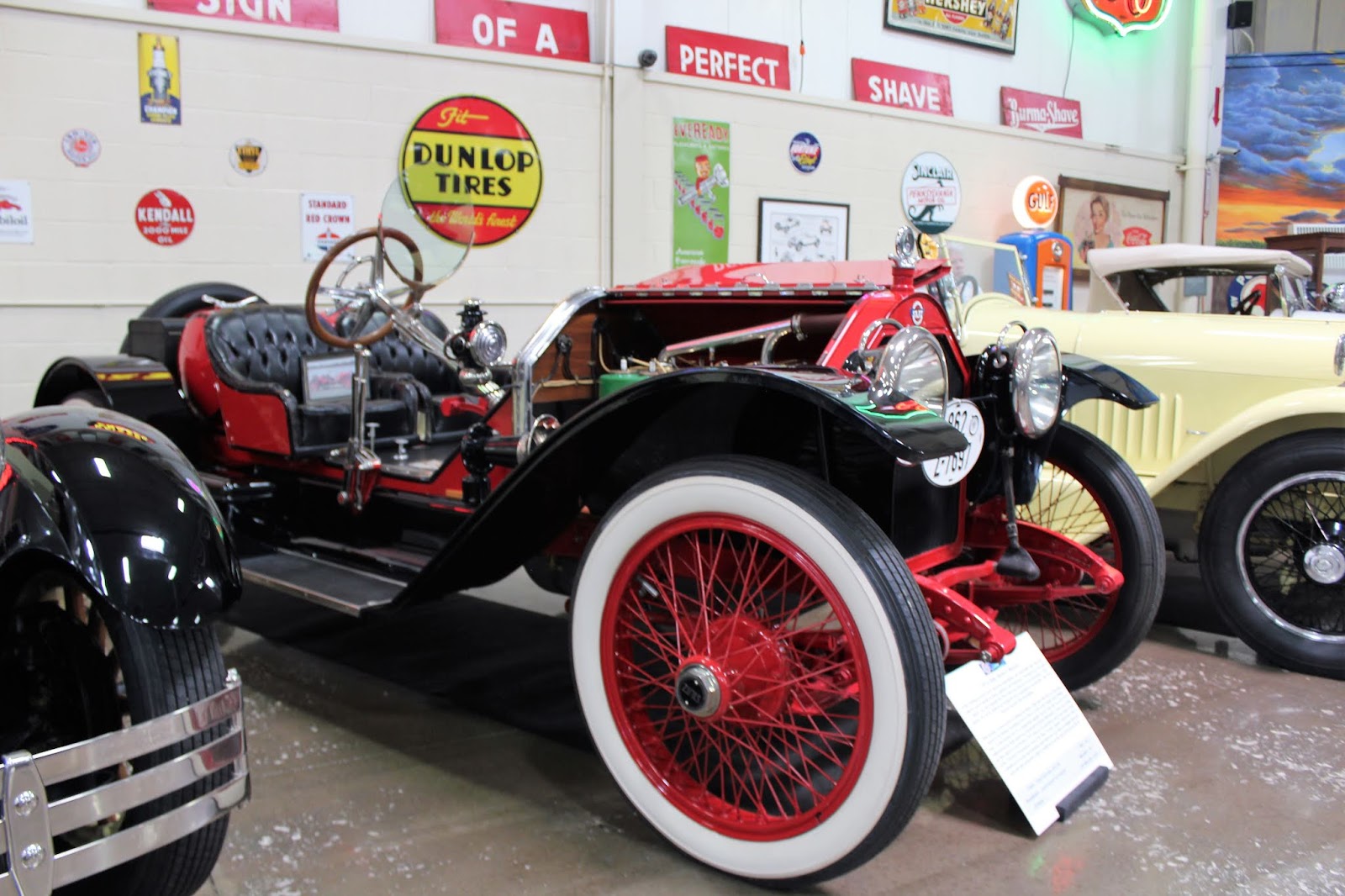
There are a number of hot rodded or reproduction cars in the Stahl Museum that are really fun.  Here is one of my very favourite vehicle in the whole place. This vehicle began life as an unrestorable 1925 American LaFrance ladder truck and is the product of the imagination of its owner, Richard Prizen and Deoon and Jeff Hammers of Penn-Dutch Restorations. The only parts remaining of the original fire truck are the wheels and running gear. Everything else is new design and construction, including the body, seats, fenders, cowl, hood and radiator. Power steering was installed, along with heated seats, external mirrors and modern shocks and sway bars. This vehicle weighs in excess of 6000 pounds. The engine was rebored as part of the restoration process, and now displaces more than 1,000 cubic-inches (over 15 liters). The top speed is in excess of 100 mph.

1922 Mercer Series 5 Raceabout
The Mercer Company, financed by the famed Roebling family, is often attributed to be the first company in America to build a sports car. The company introduced the Raceabout in 1910 which could be used as a road car or a race car without any additional modifications. The car was coveted for its quality construction and exceptional handling.


1927 Essex Super Six Speedabout
Introduced as a lower-priced companion to the parent Hudson marque in 1919, the Essex soon became synonymous with both high performance and reliability when an example averaged over 60 mph for 50 hours in December 1919, a stunt which the company followed up by a successful four-car transcontinental trek in 1920.

Founded in Detroit, Michigan in 1910, the Hudson Motor Car Company took its name from Joseph L. Hudson, who provided the finances that enabled a group of experienced ex-Olds Motor Works employees to embark on a new automobile manufacturing venture. Incorporated in February 1909, Hudson built its first car in July of that same year and 12 months later had sold 4,000 units, the industry's best first-year sales record to date. Although the firm would later become famous for its record-breaking Super Six range, Hudson's first product was a four-cylinder car, as was that of companion marque Essex.

Essex pioneered low-cost closed coachwork in the United States, its four-seater sedan being only slightly more expensive than the tourer in 1922 and marginally cheaper by 1925. Essex's big news for 1924 was the switch from four to six cylinders. The new sidevalve power unit started life at an unusually small - for the United States - 2.1 liters capacity before being enlarged to 2.4 liters part way through the year. Renamed 'Super Six' for 1927, the Essex gained a larger and more powerful engine that year and four-wheel Bendix mechanical brakes the year after. Stylistically, the Essex looked broadly similar to its Hudson parent, albeit on a smaller scale.

Of the Essex lineup in 1927 the most exciting model available was unquestionable the Speedabout. A boattailed roadster body with a leather trimmed cockpit by Amesbury, Massachusetts coachbuilder Biddle & Smart—which bodied many of more limited-production bodies—it was sleek and fast thanks to a special gear set found only in this model that gave it 80mph performance. Its strong curb appeal helped get buyers into the showroom—more often to buy one of Essex's more practical, and expensive, models. It is unknown exactly how many Speedabout were made, but the numbers were slim and today only about a dozen still exist.


1914 Stutz Series 4E Bearcat
In the catalog of great early American automobiles, the memorable Stutz “Bearcat” conjures up an image of speed, glamour and endurance. The Bearcat is very much a sports car and arguably the first American road car to earn the name. Harry C. Stutz designed a number of cars and in 1911 he founded The Ideal Motor Company in Indianapolis, Indiana. A true sports car can be defined as having the bare essentials for practicality.


1925 Kissel Speedster "Gold Bug"
The Kissel Company was located in Hartford, Wisconsin and built high priced, luxury automobiles from 1907 until 1931. The company was started by a German immigrant family who made their fortunes in farming, and later by manufacturing farm supplies and building hardware. The most famous models built were the Goldbug Speedsters built during the 1920s and popular with celebrities. The Kissel Company introduced the eight-cylinder speedster in 1925 to compete with other models. Four passenger seating became available with the rear storage converted into a rumble seat.


1927 Franklin 11-B
The Series 11 Franklin was the first Franklin model to be styled by an outside designer. Previously, Franklin motor cars were styled by factory engineers. Franklins were long known for their progressive engineering, scientific light weight, responsive handling, and dependability, but had not previously been known for their design.

In 1923, due to changing public tastes and slumping sales, as well as at the insistence of Los Angeles dealer Ralph Hamlin, the company retained the services of J. Frank de Causse. de Causse had long worked in automotive design, and for many years had styled for Locomobile. He was given carte blanche by H. H. Franklin to style a car that would sell.

The Series 11 cars were the first low profile sleek Franklins. The styling represented a radical change from previous designs. Gone was the tilting "Wilkinson Hood", replaced by a false radiator front and traditional center-hinged hood. Several new body styles emerged including the "tandem sport", and the "boat tail sport runabout". These sleek low profile cars were as distinctive as the earlier designs, yet well advanced and strikingly beautiful. Earlier designs had been based on Wilkinson's proven "Form Follows Function" axiom. With the "roaring twenties" in full bloom the public now demanded style and de Causse delivered.

The Series 11 Franklin was the first air cooled Franklin to utilize a false radiator shutter front. The cars had similar engines to earlier models however copper fins were used on the cylinders in place of steel, providing upgraded cooling, higher compression, and more power, up from 25 to 32 horsepower. These lightweight cars sat on a 119" wheelbase and used modern balloon tires. This Series is recognized as a Full Classic™ by the Classic Car Club of America.

This particular Franklin, in the very rare three-passenger coupe body style, has never been restored but has been carefully maintained and conserved.  It has been driven only 30,894 miles, with only 20 miles since 1948.  The exterior paint and interior leather show little wear and the car is one of the last to be built with the Franklin wood frame chassis.


1913 American Underslung Scout Type 22A
Of the multitude of early car companies to adopt the name “American” it is the American Motors Company of Indianapolis, Indiana that we feature here. American was a small firm that arrived with a grand flash, and disappeared in just eight years. Thanks to its most popular and distinct model, this iteration of American Motors is most commonly referred to as American Underslung.

The Underslung chassis was designed by Fred Tone in 1907, and it featured the suspension and axles mounted above the frame to allow for a much lower ride height. Tone was one of the first engineers to appreciate the value of a low center of gravity as it benefits handling, and period advertisements bestowed its virtues. This example is a 1913 Scout, a two-seat runabout roadster powered by a 30 hp four-cylinder engine. With its lower price and smaller L-head engine, junior model Scout was introduced in hopes of boosting sales when compared to the large 60 hp touring cars. But it was too-little too-late and American Motors Company closed its doors in 1914.

This Scout is believed to be 1 of only 5 built during 1913.


1914 Locomobile Model 48 Touring
The Locomobile Company of Bridgeport, Connecticut was one of the most prestigious American cars in the early twentieth century. They came into being in 1899 selling a steam-powered runabout that was based on the Stanley steam car design. They switched from steam cars to gasoline powered vehicles in 1903. Unlike most automobile companies that produced a low priced model, Locomobile continued to produce only expensive luxury vehicles. The early reputation of the Locomobile Company was achieved through racing and technical triumphs. In 1908, they were the first American automobile to win the Vanderbilt Cup race held on Long Island. In 1912, the company introduced a superior straight six engine that remained a constant power plant until 1925. Acquired by Billy Durant in 1922 and added as the most expensive car in the Durant line, production ended in 1929.

This seven-passenger touring car, built on a 140″ chassis was priced new at $6,000, nearly ten times what a Ford Model T would have cost. It is one of the largest American cars built before World War I. It’s equipped with a pair of rare Warner Autometers: one for the driver – the other in the passenger area.

1909 Carter Car Model H
The Carter Car Company was started by Byron Carter in 1905. Byron Carter was the most successful developer and builder of the friction drive transmission which differed from other vehicles of the period which used either a two-speed, planetary transmission or three-speed sliding gear transmission. The friction drive transmission used a large drive wheel which, when positioned perpendicular to the clutch, created a variety of speeds – not just the two or three seen in conventional transmissions. His company was purchased by Billy Durant in 1908 and became part of General Motors until the Carter brand was discontinued in 1915.


1904 Cyklon Cyklonette Trike
This intriguing Cyklonette trike was built by the Cyklon Maschinenfabrik GmbH in Berlin, who manufactured French motorcycles under license. Cyklon introduced the first of their three-wheelers at the Leipzig Motor Show in 1902. Their experience with motorcycles is evident in the unique layout of the Cyklonette – with the engine mounted over the front wheel, driving it with a chain and controlled with a tiller with hand controls. The body is constructed of distinctive perforated metal coachwork with inlaid wickerwork detailing.

A certain amount of manual dexterity is required to operate the Cyklon, as throttle, mixture and ignition controls are all mounted to the tiller steering, but once on the go it is easily mastered. The gearing is by a simple Crypto gear on low speed and fixed drive on high speed. It can be driven from either the left or right seat, a rather handy feature as driving duties can be handed off without stopping! Suspension is by simple cart springs and provides a reasonably comfortable ride on pneumatic tires mounted to wire wheels. The quirky little Cyklon actually remained in production until 1922, which makes quite a statement to the integrity of the original concept.

1931 Ford Model A Deluxe Roadster
The Ford Model A, introduced in late October, 1927 as a 1928 model, was such a radical departure from the Model T that Ford closed its factory for almost six months to re-tool the new model. The Model A featured a refined four cylinder engine with a 200.6 cu.in. displacement and rated at 40 hp. The engine was now fitted with a conventional distributor ignition system, a water pump and a state of the art updraft carburetor and was coupled to a sliding gear three speed transmission. Safety features included a mechanical four-wheel internal expanding brake system and new shatterproof window glass.


1911 Ford Model T Torpedo Runabout
Ford’s Model T is one of the most significant inventions of the 20th century. It is the car that put America (and much of the rest of the world) on wheels. Built on Henry Ford’s moving assembly line, the Model T was built in numbers that were previously unheard of in the manufacture of such a complex machine. After nearly 20 years of production, Ford had produced over 15 million Model Ts.

Ford offered a wide variety of body styles from the factory, from practical to sporty. For 1911, the sporty end of the spectrum consisted of the 3-Passenger Runabout, 2-Passenger Torpedo Runabout and 2-Passenger Open Runabout. The primary difference between the latter two is that the Torpedo Runabout has doors, while the Open Runabout features a step-through body. Ford’s “all black” paint policy would not take effect until 1914, with the only gray, green, red or blue offered until then.


1906 Pierce-Racine Model D
The Pierce-Racine Company was established in 1904 in Racine, WI. It was founded by Andrew J. Pierce who was a former engine superintendent at the Racine Hardware Company, which built engines for various farming and industrial use. (This Pierce has no connection to the more famous Pierce-Arrow firm in Buffalo, New York). In 1909, sales were on the rise and Pierce reorganized the company with financial backing from area business men who were also prominent stockholders in the Case Threshing Machine Company, and changed the name to Pierce Motor Company. Sales of the Pierce began to dwindle and by 1911, the Pierce Motor Co. was purchased by the Case Company who would incorporate Pierce’s assets into a new car company using the name Case. This 1907 Model D is believed to be the sole remaining Pierce-Racine vehicle. In the early 1930s it was owned by the Pacific Automobile Rental Company in Los Angeles, CA who rented vehicles to the motion picture industry.

The vehicle was likely used in numerous films until the company went out of business in the 1980s and auctioned off its collection.

1904 Oldsmobile Model N "French Front" Touring Runabout
This attractive Oldsmobile differs from the cars the company was famous for in its early years. The Curved Dash Olds’ signature look in this era, but this Model N has what is termed a “French Front” – a more traditional look styled after cars from France. Available only in 1904 and 1905, the Touring Runabout was powered by a 7 hp, single-cylinder engine of 1.9 litres. It was more upscale than the Curved Dash, featuring an Oldsmobile first: a steering wheel! It cost $100 more than the Curved Dash at $750. It was available in either dark green or dark red. Oldsmobile built 2,500 cars in 1904 between the Touring Runabout and a related model, the Light Tonneau.

This car was part of the General Motors Heritage Collection until 2011.


1899 De Dion-Bouton Tricycle
Count Albert De Dion was born of French noble descent and engineering genes. During his early years, he had an obsession with steam engines. De Dion entered a partnership with George Bouton building steam-powered carriages, and by 1895, had built several successful machines.
In the early 1890’s, the Count began to have doubts about the superiority of steam engines and started to experiment with internal combustion gasoline engines. In 1894, he designed a revolutionary single-cylinder engine of 137 cubic centimeters (cc) with an electric ignition and a speed of 3,000 rpm.


1912 Stoddard-Dayton Fire Chief Car
Stoddard-Dayton can trace its roots to well before the turn of the twentieth century. Prior to making automobiles, they made agricultural equipment and tools. In the early 1900s, Charles Stoddard had become very interested in motorcars as they began to appear on the roads – and he decided to build them on his own. He sold off his agricultural business to fund his project, and built his first car in 1904. Stoddard-Dayton cars swiftly grew in price, size and power, and sales increased steadily, even in the face of mass-produced competition from Ford.  Known for its reliability, quality and performance, the Stoddard-Dayton was an ideal choice for a quick-response fire vehicle.

This 1912 Model 20 Stratford is equipped with a fascinating and beautiful body by Prospect Fire Engine Co. Given its beautiful quality and expensive equipment, it was most likely a Fire Chief’s car, ideal for rapid response to emergencies.


1913 Woods Mobilette
The Woods Mobilette automobiles were built in Harvey, Illinois between 1913 and 1917. The car was touted as “America’s First Cyclecar”, one of over 233 cyclecar companies which existed in North America for only a short period of time. Mr. Francis A. Woods’s first Mobilette prototype Model No. 1 was built in 1910. Sometime during 1911-1912 he built the Model No. 2, which was powered by a four cylinder 12 HP air cooled engine. Model No. 3 was his first production model with both staggered seat (Sociable) and Tandem seating roadster being powered by a 12 HP water cooled Woods Mobilette engine. 

The Mobilette engines were foundered by several foundries over the course of production. The Model No’s. 4 – 4A’s consisted mostly of specialty small trucks, both pickup and panel truck types. One of the founders of the practice of cosmetic surgery, Dr. Samuel L. Scher, took very good care of this vehicle until the mid-60’s when it was taken in by Richard C. Paine Jr at the Seal Cove Museum. It was brought to the Stahl Museum in 2008 in beautiful condition. Being a 1911, it is generously outfitted with brass brightwork, from the radiator shell and acetylene headlights to the E&J kerosene sidelights and taillight and brass tube windshield frame. It deservedly earned the AACA National First Prize plaque.


1912 Rolls-Royce Silver Ghost
When the 40/50 horsepower “Silver Ghost” debuted in 1907 it was the most advanced motorcar money could buy. Centered on Henry Royce’s 7,428cc side-valve inline-six, the Silver Ghost was an engineering marvel. The cylinder block was built incredibly strong but was also light weight due to the use of an alloy crankcase. Royce’s engine had a crank that was shorter and stronger and was supported by seven large main bearings. Features like pressurized oiling, fixed heads to eliminate leaks, and a twin ignition system via magneto or distributor were advancements that set the Silver Ghost as the standard.

This 1912 Silver Ghost was once sold to the British Admiralty where it served war duty. Throughout its life, it wore several bodies, which was not uncommon and it was often a chassis would outlast more than one body. In 1988, it was fitted with its current “Roi des Belges” or “Tulip Phaeton” body by Wilkinson, a style made popular the early 1900s by Barker.


1914 Cadillac Military Sports Roadster
As the teens rolled into the twenties, many owners of high quality Brass Era motorcars were facing a dilemma. Their machines were falling out of fashion as automakers introduced new, ever more modern body styles. Owners could cut their losses and sell their perfectly good automobiles, or simply order a new body to make their older car look new. This became a rather common practice for owners of extremely high quality cars such as Rolls-Royce, Locomobile and Cadillac.

This 1914 Cadillac is one such car that received a new body when it was just a few years old in order to keep it in vogue. Originally a 2-passenger roadster, the Cadillac updated in 1919 with this 2-passenger “Military Sport Roadster” body by Schutte Body Company of Lancaster, Pennsylvania. Schutte bodies were known for their unrivaled quality, and were often seen fitted to the finest cars in America. This is believed to be the only Cadillac to wear this sporty Military Sport Roadster body. This vehicle was retained by the same family for 98 years.


1923 Wills Sainte Claire A68 Rumble Seat Roadster
C. Harold Wills used the $1.5 million he'd received in severance from Henry Ford to help capitalize on his new car. Wills named his automobile the Wills Sainte Claire, after himself and the river that ran near his new Marysville, Michigan factory. The Canada grey goose, a bird greatly admired by Wills, was portrayed on the new car's radiator ornament.

Drawing inspiration from Hispano-Suiza WWI aircraft engines, Wills designed an advanced 265-cid monobloc V8 with two overhead camshafts for his new car. Precise bevel drive gears improved upon the noisy straight gears of the Hispano design, making the Wills' V-8 whisper quiet. The motor would be fed through a dual throat carburetor, and it exhibited the excellent response one would expect from such an advanced design.

Castings of molybdenum steel, a Wills development, helped keep the 121-inch wheelbase Wills Sainte Claire light and nimble. Starting in 1925, Wills offered a SOHC 6-cylinder engine alongside the V-8. More than 12,000 Wills Sainte Claire cars were produced between 1922 and 1927, the year production ceased. Wills' admiration for the engineering of Hispano-Suiza was reflected in the flying goose logo of the company.

Unfortunately Wills' passion and perfectionism did not benefit his business model. He constantly shut the production line so he could make improvements. His V-8 masterpiece was incredibly expensive to produce and the low output of the company would never yield a profit. Wills would fade away in 1927, with some of his team helping to develop the Ruxton front drive car.

Due to their high quality and amazing technical specification, Wills St Claire cars have always been prized collectors' items. William Harrah, J.B. Nethercutt, and Briggs Cunningham all had fine examples of Wills cars in their collections. The Wills represents a level of technical sophistication not seen in other American cars of this time period.

This Model A-68 V-8 Rumble-Seat Roadster is one of 1,659 Wills Sainte Claire cars produced during 1923. The Roadster was designed to be the performance showcase for the V-8 engine. A lightweight and nimble car, the model featured high ratio gearing to better harness the performance of the motor. The body was clean and the styling up to date for the early 1920s. Wills differentiated his cars with some novel visual features such as the distinctive headlamps and the drivers courtesy light, which faired into the cowl.


1917 Haynes Model 37 "Light Six" Roadster
Elwood Haynes had his start in the automobile business in 1893 when he purchased a Sintz marine engine, which he intended to install in a horse buggy. Lacking the necessary machinery to make the transmission and other mechanical parts he approached the Apperson Brothers machine shop and by July 4th 1894 drove his car down the streets of his hometown of Kokomo Indiana. Haynes and Apperson began building cars in 1898.

Haynes was fond of telling people that he built “the first car in America” a story he told for years. But the Duryea Brothers are credited with being the first to build a production vehicle in 1893. Haynes is credited with inventing stainless steel and the thermostat.

This 1917 model 37 Light Six roadster features a unique body, having two doors and what appear as very early bucket seats for the front passengers and a passageway to the back seat. Haynes moved the gearshift forward in 1916 to allow this unusual seating arrangement.

Powered by an in-line six cylinder engine of 288 cubic inches, this car had a top speed of 60 mph. The company produced cars from their Kokomo factory until 1924, when creditors petitioned the US federal court to declare Haynes bankrupt. Elwood Haynes died in April of 1925, and the hope of saving the company died with him.

1917 Oakland Model 36 Touring
Oakland automobiles were built in Pontiac, Michigan from 1907 until 1931. The company was founded by Edward M. Murphy who built horse drawn buggies and Alanson P. Brush who was formally involved with Cadillac. W.C. “Billy” Durant negotiated the purchase of the new company in 1909 and made it part of the General Motors empire. The 1914 Oakland is one of the first, lower priced, American production vehicles to have electric lighting as well as an electric starter, eliminating the need to use the difficult and sometimes dangerous hand crank.


1907 Thomas Flyer
In February 1908, the New York Times and the Parisian newspaper Le Matin teamed up to sponsor a race from New York’s Time Square to Paris, by way of San Francisco, Vladivostok, and Moscow. Six cars from 4 nations entered: a German Protos, a Züst from Italy, and three French cars. The lone American entry was a 1907 Model 36 Thomas Flyer, piloted by racing driver Montague Roberts and mechanic George Schuster. With 6 fuel tanks holding 176 gallons of gasoline, and the car’s custom built 60-hp, 4-cyl engine, the Thomas was ready.

Consistently the leader across the United States, the Thomas reached San Francisco on March 24th. Only the Züst, the Protos, and the Thomas made it past Vladivostok. The Züst expired in Siberia, leaving the Protos and Thomas to duke it out across Asia and Europe in a dead heat. The Protos reached Paris four days before the Thomas, but it was found they had used rail shipment for part of the journey and were penalized 30 days. The Thomas, with Schuster at the wheel, made a triumphant entry to Paris on July 30th resulting in great prestige for the American auto industry and for Thomas in particular. Thus, the Thomas Flyer signifies the coming of age of the early American automobile industry.

This car shares the same great heritage and bloodline as the famed around-the-world Thomas. The Thomas Flyer was one of the most powerful, elegant cars of the first decade of American Auto manufacturing.

There are only 3 authentic 1907 Thomas Flyers remaining.


1926 AC 12/24  Royal Roadster
By 1907, Autocars and Accessories Ltd. had reorganized as Autocarriers Ltd., which continued until 1921, when well-known British motoring entrepreneur Selwyn F. Edge gained control of the firm. Founders John Weller and John Portwine resigned, and Edge proceeded to rename the company AC Cars Ltd., the name by which it would continue to produce automobiles for decades to come.

In 1926, most AC products were powered by the two-liter, six-cylinder, overhead-cam engine that Weller had designed in 1919 and which the company would produce with continual improvements until 1963. The 12/24 was an exception, as it was powered by a 1,496-cubic centimeter, side-valve, four-cylinder engine that was supplied by well-known British motorcycle manufacturer Anzani. This would be the final year that a four-cylinder model was available, but with peppy performance and attractive design, no one could say that it did not go out with a “bang.”

Technical specifications: 24 bhp, 1,496 cc SV inline four-cylinder engine with two valves per cylinder, three-speed manual transmission, live front and rear axles with quarter-elliptic leaf-spring suspension, and rear-wheel mechanical drum brakes. Wheelbase: 105 in.

1929 Durant
Durant Motors, Inc. was organized in 1921 as a $5,000,000 company with more stockholders than any other company except American Telephone & Telegraph. It was founded by William Crapo Durant, one of the most spectacular and colorful entrepreneurs in American automobile history. Durant had previously founded General Motors and lost it twice. Within two years of founding Durant Motors, it had a variety of brands including the Durant, Star, Flint, Locomobile, and Eagle, all rivaling the range offered by GM.


1931 Chevrolet Landau Phaeton
The 1931 Chevrolets were called the Independence models and were built on the same chassis and powered by the same six cylinder overhead valve engines that were introduced in 1929. This engine was built in response to Ford Motor Company’s success with their new Model A introduced in 1928. This new engine would be used with minor modifications until the late 1950s in Chevrolet passenger cars and trucks. Twelve body styles were offered in 1931 and the bodies were built by Fisher Body. The 1931 models featured headlamps mounted on a dramatically curved cross bar, a higher and larger radiator, and a redesigned hood with opening louver doors. Wire wheels were now standard equipment.

From left: 1914 Rauch & Lang Electric Vehicle; Ford Model T Speedster; 1911 Ford Model T Torpedo Runabout; 1931 Ford Model A Deluxe Roadster

1957 Ford Thunderbird
1963 Volkswagen Type 2 "23 Window" Super Deluxe Microbus with 1967 Eriba Puck Camping Trailer

1952 Morgan Dellow


According to extensive records and correspondence accompanying this very special, flat-radiator Morgan, Graeme Anton went to Peter Morgan in early 1952 to purchase a Plus 4 Roadster. His plan was to take delivery prior to leaving for University of Cambridge, but he was disappointed to learn that the steel that had been allotted to the Morgan factory for the remainder of the year had been allocated to cars already sold and scheduled for delivery. In order to meet the deadline, Mr. Morgan offered to sell Mr. Anton a rolling chassis prepared for receiving outside coachwork. For the coachwork, Mr. Anton approached Lionel Evans of Radpanels in Kidderminster, England. Radpanels had gained notoriety for having built the bodies for the successful Dellow trials cars (earning the car its lifelong nickname), and the two men struck a deal that would allow the car to be completed in time for Mr. Anton's departure for school.

Construction techniques at Radpanels were markedly different from that of the Morgan factory, with the coachwork of this car being built over a steel tube frame rather than the ash wood used in the Morgan-bodied cars. Also, as Mr. Anton had been wounded while serving in the British Army, the doors were hinged at the rear to allow him easier access to the cockpit. The car was registered LAB 274 and delivered to its proud owner on September 30, 1952. Once at university, Mr. Anton joined and competed in the events of the Cambridge University Auto Club, taking part and placing in numerous rallies and hill climbs.

In later years, the Plus 4's second owner, Quentin English of the British Morgan Club, acquired the car and competed in various club trials and sprints, winning a President's Cup in the Club Trophy with the car. Registration certificates from a portion of the 1970s are included with the documentation and apparently the Morgan sat unused through the 1980s. Its known history resumes in 1991 when the car was acquired by Melvyn Rutter. The following year, the car was enjoyed around England under the ownership of John Banner and even used by a friend for a honeymoon to the South of France. By the mid-2000s, the car had covered a mere 47,000 miles and was in the ownership of John Baroth who, with a friend, began to piece together the history of LAB 274.

During the research, Mr. Baroth made contact with Mr. Anton, documenting his memories of the car when new. Mr. Anton sent many period competition photos and other items to Mr. Baroth, including the original green paint and leather samples that he had kept for nearly 60 years. Altogether, the history file for the Dellow Morgan is remarkably complete, filled with numerous receipts of restoration work but perhaps more importantly, with several handwritten letters from the car's original owner Graeme Anton and notes from many of its other caretakers.

The car was subsequently restored in the UK to its original specifications utilizing the wealth of knowledge that had been collected. The Plus 4 then caught the attention of a major stateside Morgan expert and the Dellow Morgan was purchased and imported to the US for the first time in its history.

Kirkham 427
Kirkham Motorsports of Provo, Utah, offers accurate replicas of the famous Shelby 427 Cobra featuring aluminum bodies built in a former Polish airplane factory. The quality of the craftsmanship is evident when looking at an unpainted shell.

1936 Mack Jr Pickup Truck
In 1935 an agreement was reached between Mack Truck Company and the REO Motor Car Company that allowed Mack dealers to market smaller REO Speedwagon trucks at Mack dealerships. Mack was convinced it could sell a small Mack truck so REO agreed to build it at its assembly plant in Lansing, Michigan. The 1936 Mack Jr. pickup truck is a basic REO pickup with Mack Jr. identity.


1947 Mercury Half Ton Pickup Truck
After the end of World War II, Ford Motor Company of Canada developed a new marketing plan, which effectively divided its existing dealerships into two groups: Ford and Lincoln-Mercury. Those selling the more expensive Lincoln-Mercury brands complained about losing their very strong selling light-duty commercial vehicle sales. To remedy this, a new line of pickups were released carrying the Mercury nameplate.

Besides being built for rugged duty, they were also quite handsome, actually pioneering the idea that the driver and those with him deserved much better creature comforts. While the Mercury pickups shared the same basic sheetmetal with the new F-series from Ford, they were distinguished by the use of special trim. A distinctive four-bar grille was used up front, flanked by a stylish wrap-around trim mounted on the fender's seam line, with specific badging in the center of the hood, which also wore quite prominent side trim. To the rear, the name M-E-R-C-U-R-Y was spelled out in bold lettering, leaving no doubt that this was a proud, pure truck.

Vending Machines on Route 66 Display
Ihle Schottenring
Generally credited with developing the signature BMW kidney grille, the Ihle brothers, Frank and Thomas, of Bruchsal, Germany, also built such racing cars as a competition variant of the BMW Dixie. After selling their racing car business to BMW, they established “Gebr. Ihle,” which translates to “the brothers Ihle,” aimed at producing cars for amusement parks and fairs.

These cars are extremely rare and collectible. This particular example is powered by a Hirth two-stroke, single-cylinder motor producing about seven horsepower, accessed through a simulated spare tire cover at the rear. With a length of only 93 inches and a weight of only about 600 pounds, it is a delightfully sprightly little motor car, finished in cream and orange with one of two available front nose sections from Ihle, the other of which was simply intended to create some model differentiation in Ihle’s lineup.

Slowing down from a projected top speed of about 25 mph is accomplished via rear cable brakes.