Showing posts with label Le Mans. Show all posts

Saturday, October 26, 2019

2019 Corvette Racing Weekend: Hershey, Pennsylvania, October 25-26, 2019


There are a number of "official" Corvette events held around the country each year, including a Corvette Corral at the 24 Hours of Daytona each January supported by Chevrolet and a dinner event on the West Coast after one of the races out there but a more recent event is the Corvette Racing Weekend, which seems to have started at the Simeone Museum in Philadelphia in 2016 (my posting about that one is here) and has subsequently become an event organized by the National Corvette Museum and has relocated to the AACA Museum in Hershey, Pennsylvania.  We were unable to attend the events there until this year as they were held too late in the season to allow us to drive the Corvette as it goes into hibernation on November 1 each year.  In 2019 the event was moved forward and we were able to participate.

After the initial Meet and Greet at the Troegs Brewery on Thursday, October 24 and then the poker run to the coal mine and Yuengling Brewery on Friday morning and afternoon, we walked over from our hotel across the parking lot to the AACA Museum on Friday night for a buffet dinner and were entertained by Corvette Racing Program Manager Doug Fehan and driver Tommy Milner, who always are good for insider insights into racing.  The 2019 season was actually not very good for the team and Friday's talk was about the 24 Hours of Le Mans.  82 laps into the race, the No. 64 car, being driven by Marcel Fässler, a Swiss driver who is a three-time class winner at Le Mans, was struck by a Porsche in the LM GTE Am class, and the Corvette slammed into the crash barriers with considerable force, ending the race.  The story went that the Le Mans organizers have a system in place that detects hard impacts so that emergency vehicles can be sent out immediately but in spite of the impact, which registered like an earthquake, nothing happened.  Marcel, shook up but uninjured, got out of the car and waited around before taking a ride on a marshall's scooter to the medical unit. Marcel was blamed for the incident and was fined by the stewards but it is clear from the video that the Porsche was at fault.

The No. 63 Corvette lasted until late in the race when it was beginning to make the charge to move up in the rankings but instead driver Jan Magnussen lost control on a turn and spun off the road.  The car was repaired but the damage meant that it finished far down in the standings after completing 337 laps.  This was the last time the Corvette C7-R would be at Le Mans so it was a disappointing day out for the team.  The Ford GT was also at its last Le Mans as part of a factory team and also fared poorly, with two cars (one a factory racer, the other the first Ford GT privateer) disqualified.

Lance Miller, of Carlisle Events, talking about the 1960 Briggs Cunningham team Corvette
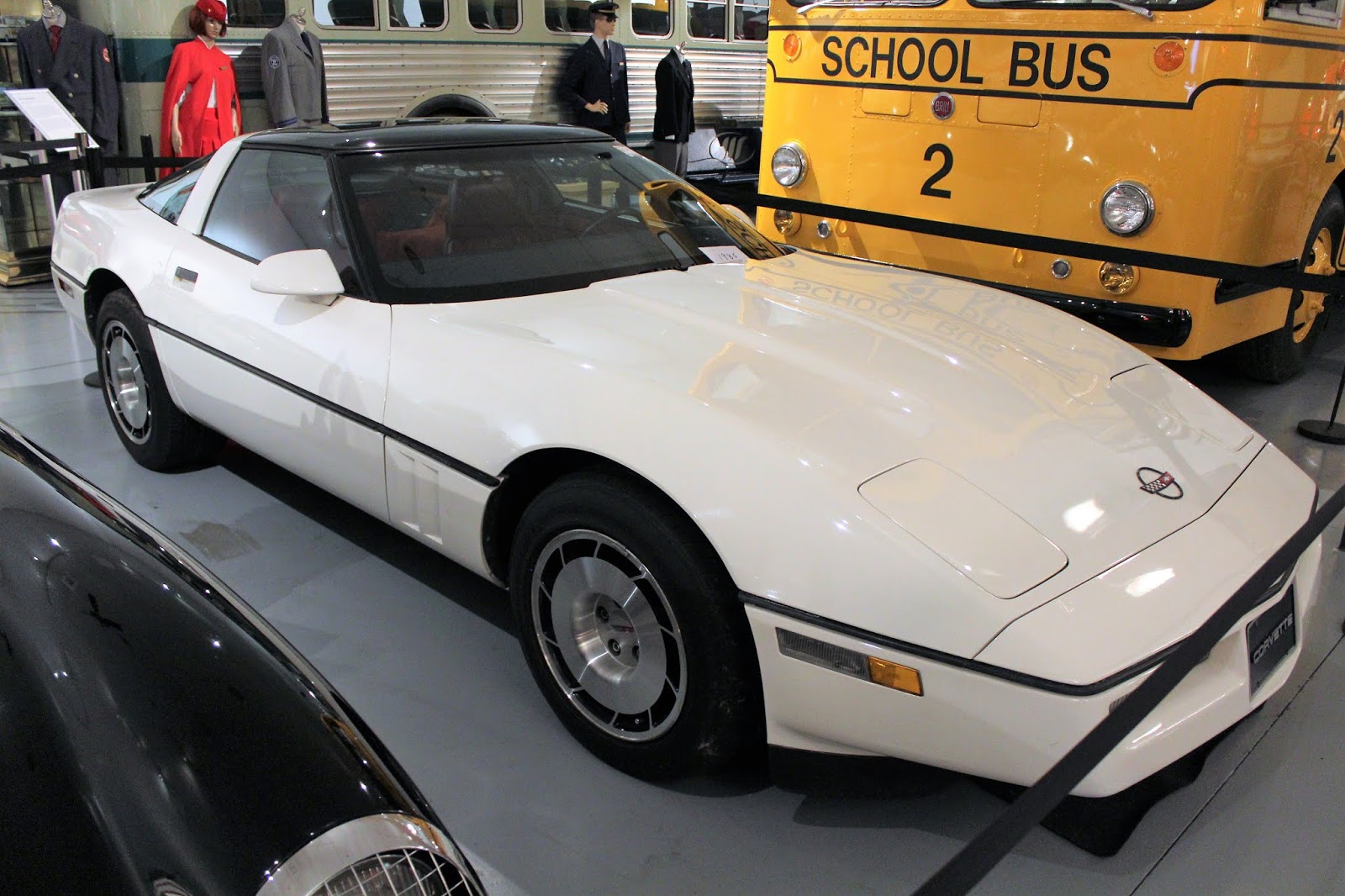
Getting up early on Saturday, we had breakfast and then enjoyed a pre-event walk-through of the storage building of the AACA Museum, which I wrote about here.  Soon afterwards the Corvette Racing Weekend part continued in the downstairs area of the museum.  We walked in just in time to hear the last part of Lance Miller's talk about the 1960 Corvette that had raced as part of the Briggs Cunningham team effort at Le Mans that year.  It was the first year that Corvettes had participated and in addition to the three Cunningham cars there was an additional Corvette fielded by Camoradi USA.  It had been a dream of Lance Miller's father, Chip, to find the original No. 3 Cunningham Corvette that had been the class winner at Le Mans, and after considerable effort and expense the car was found and restored to its original race configuration.  Lance brought the car to the museum and it was on display for all to admire, along with two other Corvettes.
<

1960 Cunningham Team Corvette Le Mans Racing Car
One of the most celebrated of all Corvettes, we first had the opportunity to see this car at the Greenwich Concours d'Elegance in Connecticut in June 2018, which featured the cars of Briggs Cunningham, where I spoke to Kevin McKay, the restorer.  Then the car appeared with a exhibition of Corvette racing cars at the 2019 Corvettes at Carlisle event in August--and a week later it was on display at the National Corvette Museum as part of the museum's 25th Anniversary celebrations!

1954 C1 Corvette Roadster

1985 C4 Corvette Coupe
After the presentation by Lance Miller, we heard from a number of other speakers, with Wes Wong, who is a Board Member of the National Corvette Museum, acting as Master of Ceremonies.  Doug Fehan and Tommy Milner were back to talk about the overall 2019 season for Corvette Racing which, alas, saw the team fail to win a single one of the 13 races entered (the WeatherTech SportsCar Championship series plus the 24 Hours of Le Mans).  It was clearly Porsche's year as that team won six of the 12 WeatherTech races, or possibly, the Balance of Performance set-up favoured their cars.  BoP is a hot topic in racing but, realistically, there is no way that such divergent cars could be made to race with each other competitively unless there was some way to equalize things.  We also heard comments from Tommy Milner about what it is like to drive the new Corvette, the mid-engined C8-R, that will be present at the 24 Hours of Daytona in January for its first race.  One of the cars will be silver with yellow details, while the other will be the traditional Corvette Racing yellow with some silver.  There seemed to be a difference of opinion as to which colour should have been used!
Driver Tommy Milner (left) and Corvette Racing Program Manager Doug Fehan (right) talking about the 2019 racing season
The program continued with a very interesting presentation by Lee Willard, the Chief Michelin Corvette Tire Engineer, who had a slide presentation about the new C8 and how the tires were developed for it, and a talk was also given by Cam Bower, Strategic Alliance Global Manager from Mobil, who spoke about the latest Mobil 1 synthetic oil technology.  Having heard representatives of these two companies at numerous events now, we are always surprised how they come up with something new and memorable to discuss.  Corvette owners are very interested in the technical aspects of their cars today but Michelin and Mobil have been with the program for years and talk about their history with Corvette as well.

The Corvette Racing Weekend then featured an auction to raise money for the National Corvette Museum, as well as some items to benefit the AACA Museum, and the Corvette fans opened their wallets with enthusiasm.  The event ended with an autograph session.  Nigel Dobbie, a super Corvette enthusiast whom we had met at the NCM's "NASCAR in the South" event in North Carolina in 2017, has just published a big book on Corvette Racing's first 20 years and we purchased a copy, which we had signed by Nigel, Doug (who wrote a foreword), Tommy and the others.
With the Corvette Racing Weekend events concluded, we were able to walk around the AACA Museum and look at the cars on display without any rush.  That evening we had attempted to go for dinner in downtown Hershey but the restaurants were packed so we ended up at Troegs Brewery yet again!

Wednesday, September 30, 2015

Racing Against Time: The Simeone Museum, Philadelphia, September 30, 2015


During my posting in Washington, I had visited many museums in that city but also in Philadelphia and New York, which were easy to reach.  Although a vintage car enthusiast, I had never heard of the Simeone Collection but since it was not actually turned into a Foundation and opened to the public until June 2008 I did not hear anything about it before my departure from DC in 2007.  On our trip back from the UCI World Championships in Richmond, Virginia, I was not letting the chance go by to see this world-class collection.  And it was well worth seeing!

Housed in a large warehouse-type building not far from the Philadelphia Airport, the Simeone Museum is the creation of Dr. Fred A. Simeone, a Philadelphia neurosurgeon who is presently a very spry 81 years old.  He and his father, a General Practioner, were both interested in vintage racing cars and when the elder Simeone passed away in 1972 his son inherited four cars stored in a garage in central Philadelphia.  Over the ensuing years, Dr. Simeone has built up what must be considered one of the very finest collections of sports cars in the world.  In 2008 he transferred ownership of his 65 cars, still stored in a garage, to the Simeone Foundation and the organization's museum opened that summer.

The collection is very specific in that the cars it includes are: sports cars with headlights and fenders (there is one notable exception); have a history of road racing; be of historical significance; and that the major components of the car be original.  There are few restored cars in the collection but rather they should be considered "preserved" to a large extent.  The cars are not just kept on static display but actually operated during "Demonstration Days" once a month when some selected vehicles are taken out and exercised in the large adjacent parking lot.

On entering the museum, located in a nondescript industrial park, one is immediately confronted with a row of wonderful pre-World War I sports cars, boasting some of the most memorable names in early motor racing.  The Simeone Museum, which is fairly chronological, begins with a very fine 1909 American Underslung Traveler, which had an interesting history as its owner was a big fan of the marque and bought four American Underslungs new, one of which was burned during a hotel garage fire on his honeymoon!  This car was restored with meticulous attention to detail in the early 1960s and is a powerful example of what is arguably a product of the first manufacturer of sports cars in the United States.  Developed by the famous Harry Stutz, they were built in Indianapolis from 1905 to 1914, after which the company went into receivership.

1909 American Underslung Traveler
The row of wonderful cars continued with a National roadster from the same era and then two of the most iconic of all American sports cars: a 1913 Mercer Raceabout and a 1916 Stutz Bearcat.

1912 National Model 40--an unrestored, original car similar to the Indianapolis 500 winner of the same year

1913 Mercer Raceabout, in original condition but having a 1911 chassis and 1913 engine and transmission.  Along with its expensive Michelin tires, it is assumed that this car was raced, the only Mercer Raceabout that may have done so.
1916 Stutz Series 4C Bearcat, 36 hp, and built in Indianapolis but this particular exmaple has somewhat questionable provenance but what a car!


The next area in the museum was devoted to the differing motor sports events in the United States, including including Watkins Glen and the Bonneville Salt Flats.  Two iconic cars were here: the prototype 1964 Shelby Daytona Coupe, one of six built, and the equally rare 1963 Corvette Grand Sport.


1964 Shelby Daytona Coupe, once owned by music producer Phil Spector, and the first car to be listed on the Historic Vehicle Association's National Historic Vehicle Registry


One of Chevrolet Chief Engineer Zora Arkus-Duntov's masterpieces, the 1963 Corvette Grand Sport was never fully developed as a racing car as GM management stopped the program before the planned 100 cars could be built for homologation.  This car is one of 5 Grand Sports built, and one of the two roadsters modified from the coupes to improve aerodynamics.  It was purchased by Roger Penske in 1966 but was no longer competitive.  The car was maintained in original racing condition for some three decades.  When last sold at auction, this car brought $5 million.

Now to Bella Italia and some cars that were raced in the famous Targa Florio and Miglia Mille events:

1926 Bugatti Type 35, probably the winningest sports car model of all time with 2,000 victories, including  four vins in a row at the Targa Florio from 1925-1929.  This car is considered the most original Type 35 in existence.
1975 Alfa Romeo Tipo 33 TT12, winner of the World Championship that year


Left: 1933 Alfa Romeo 8C 2300  Monza; Right: 1937 Alfa Romeo 8C 2900--both of these cars finished 2nd in the 1933 and 1937 Mille Miglia races, respectively


As I go through my photos, I realize that this collection is so amazing that I could spend weeks writing before I can get this post completed!  For example, while the 1933 Alfa is extremely rare as having the original drivetrain, chassis and body, the 1937 car had a very active racing career in Italy and Central Europe but ended up in various pieces in Argentina.  It was a true "barn find," and the original engine was located elsewhere in the country before the whole thing could be put back together and reunited as a beautiful car again.

I suggest that for details of all of these wonderful vehicles, check the Simeone Museum's excellent website, which gives the history of each car here.  I will just continue with my photos of  some of my favourites--which seems to be a good number of them!
1931 Bentley 4.5 Litre Supercharged Tourer by Vanden Plas, winner of the 1931 Isle of Man Time Trial 

1937 BMW 328, with 16,000 kms on it.  Hidden under hay in a Dutch farmyard during World War II, it is believed to be the lowest-mileage and most original 328 in existence


Although the central part of the museum building is dedicated to those cars with a racing history or other unique attributes, there is a wing of "sporty cars" which I found delightful.  Many of these cars were more stylish than fast but all were interesting.


1926 Kissel 8-75 Speedster, a brand that won celebrity approval (including that of  Amelia Earhart and Douglas Fairbanks) in spite of its rather mundane performance.  In the words of Dr. Simeone: "The turning radius is poor, the steering is heavy, the limpid pickup is sometimes mollified by the exhaust note when the cutout is open, but beyond this there’s only the exciting, sporty good looks. But then what was there in 1926 for sportsmen?"

1928 Auburn 8-88 Boattail Speedster


1933 Auburn V12 12-165 Speedster, a stunningly beautiful car and very rare, with only 14 having been built
1935 Auburn 851 Boattail Speedster


1929 Dupont Model G Speedster, one of perhaps 7 built, and in the ownership of a couple in St. Louis for 70 years 
1933 Squire Roadster: built to the highest standard and cost, Adrian Squire's masterpieces were clearly the wrong car for the Great Depression and the company went bankrupt after only 7 cars were built.  Squire started his company when he was only 21 and clearly had great technical expertise as the cars have been compared to Bugattis of the period.  Sadly, his life was to end at 30 in a German air raid at the Bristol Aircraft plant where he was working in 1940.


Because I love Corvettes, here is a 1966 Chevrolet Corvette Sting Ray 427 Roadster in original condition


Turning back to the white and blue Corvette Grand Sport earlier in this post, here is what Dr. Simeone has to say about Jim Jaeger's approach to historic preservation:  "Grand Sport 002 was the only car of the five that had never been restored. As a result, the car held a wealth of historic information. Much of the car was so original, many of its handmade parts still had the scribed, painted and even wax-pencil markings made by Corvette engineers during the car’s construction in 1963. In order to preserve the original body (still in its 1966 privateer colors), Jaeger commissioned a precise duplicate of the body to be crafted and finished exactly to the original Corvette Engineering configuration, and an all-aluminum 377 cubic inch engine to be built to 1964 specifications. Needless to say, no aftermarket or replica parts were used in this multi-year, Smithsonian-grade project."  Here is that replica body;  the engine is on a stand next to it.
1957 Ferrari Testa Rossa, with an extensive US racing history
1962 Ferrari 250 GTO, on loan to the Museum; it finished second overall at Sebring and 6th overall at Le Mans in 1962


The only car without headlights or fenders in the collection: one of the three 1921 Duesenberg 183 Grand Prix cars.  A sister car (four were built) won the 1922 French Grand Prix.  This car did not finish that race but came second at Indianapolis that year.  The French Grand Prix winning car is in the Indianapolis Speedway Museum, although much modified, and a third car has recently come to light and is being now restored in North Carolina.

Left: 1929 Stutz Supercharged Le Mans; Right: 1927 Stutz Black Hawk Challenger

1966 Ford GT40 MkII, one of eight GT40s entered in the 1966 Le Mans race

1929 DuPont Le Mans Speedster

1952 Cunningham C-R4 Roadster, winner of its class in the 1954 Le Mans race and third overall

1936 Bugatti Type 57G Tank, winner of the 1937 Le Mans race and the only survivor of three built

1958 Aston Martin DBR1, winner of the 1000 Km of Nurburgring in 1958, driven by Stirling Moss and Jack Brabham.  It was also raced by Jim Clark and Caroll Shelby and appeared four times at Le Mans.
1927 Mercedes-Benz S-Type Sportwagen, winner of the first German Grand Prix at the Nurburgring in July 1927

Raced in the 1967 Le Mans event, this Ford GT40 Mk IV reached a record speed of 224 mph on the Mulsanne Straight but wa later stuck in sand and was unable to be dug out to complete the race.

1938 Alfa Romeo 8C 2900B MM Spider, winner of the 1938 Mille Miglia, one of only four built--and all surviving in some form-- and considered by Dr. Simeone to be the ultimate of pre-war sports racing cars

So here is my quick survey of the Simeone Museum and we will certainly return for special events there.  We had a great time looking closely at the cars and even were greeted by a Museum volunteer walking through the building and wanting to know "Who owns the Corvette?"  A fellow-owner and not someone reporting a parking lot incident, happily!