Showing posts with label National Corvette Museum. Show all posts

Saturday, October 26, 2019

2019 Corvette Racing Weekend: Hershey, Pennsylvania, October 25-26, 2019


There are a number of "official" Corvette events held around the country each year, including a Corvette Corral at the 24 Hours of Daytona each January supported by Chevrolet and a dinner event on the West Coast after one of the races out there but a more recent event is the Corvette Racing Weekend, which seems to have started at the Simeone Museum in Philadelphia in 2016 (my posting about that one is here) and has subsequently become an event organized by the National Corvette Museum and has relocated to the AACA Museum in Hershey, Pennsylvania.  We were unable to attend the events there until this year as they were held too late in the season to allow us to drive the Corvette as it goes into hibernation on November 1 each year.  In 2019 the event was moved forward and we were able to participate.

After the initial Meet and Greet at the Troegs Brewery on Thursday, October 24 and then the poker run to the coal mine and Yuengling Brewery on Friday morning and afternoon, we walked over from our hotel across the parking lot to the AACA Museum on Friday night for a buffet dinner and were entertained by Corvette Racing Program Manager Doug Fehan and driver Tommy Milner, who always are good for insider insights into racing.  The 2019 season was actually not very good for the team and Friday's talk was about the 24 Hours of Le Mans.  82 laps into the race, the No. 64 car, being driven by Marcel Fässler, a Swiss driver who is a three-time class winner at Le Mans, was struck by a Porsche in the LM GTE Am class, and the Corvette slammed into the crash barriers with considerable force, ending the race.  The story went that the Le Mans organizers have a system in place that detects hard impacts so that emergency vehicles can be sent out immediately but in spite of the impact, which registered like an earthquake, nothing happened.  Marcel, shook up but uninjured, got out of the car and waited around before taking a ride on a marshall's scooter to the medical unit. Marcel was blamed for the incident and was fined by the stewards but it is clear from the video that the Porsche was at fault.

The No. 63 Corvette lasted until late in the race when it was beginning to make the charge to move up in the rankings but instead driver Jan Magnussen lost control on a turn and spun off the road.  The car was repaired but the damage meant that it finished far down in the standings after completing 337 laps.  This was the last time the Corvette C7-R would be at Le Mans so it was a disappointing day out for the team.  The Ford GT was also at its last Le Mans as part of a factory team and also fared poorly, with two cars (one a factory racer, the other the first Ford GT privateer) disqualified.

Lance Miller, of Carlisle Events, talking about the 1960 Briggs Cunningham team Corvette
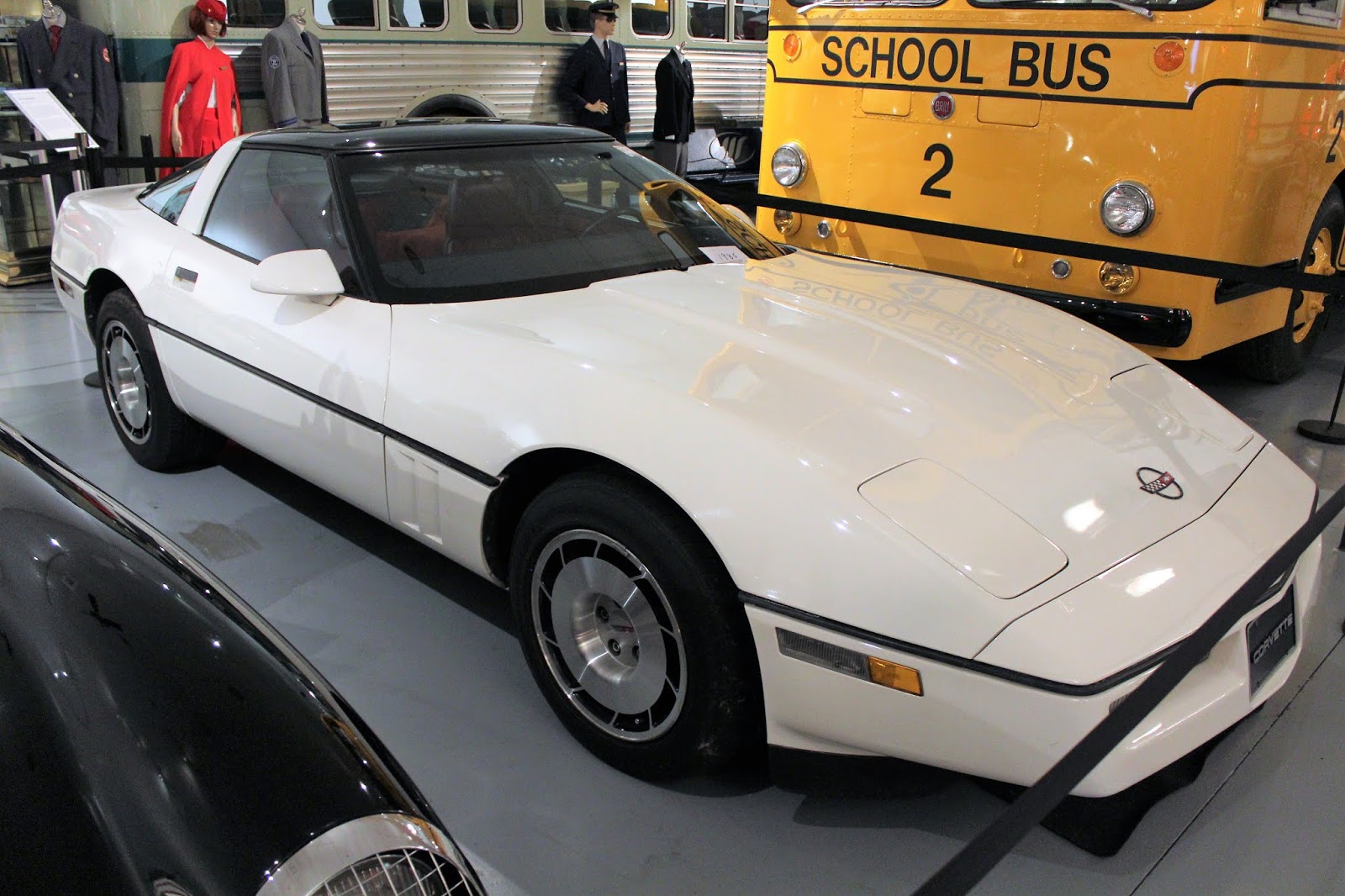
Getting up early on Saturday, we had breakfast and then enjoyed a pre-event walk-through of the storage building of the AACA Museum, which I wrote about here.  Soon afterwards the Corvette Racing Weekend part continued in the downstairs area of the museum.  We walked in just in time to hear the last part of Lance Miller's talk about the 1960 Corvette that had raced as part of the Briggs Cunningham team effort at Le Mans that year.  It was the first year that Corvettes had participated and in addition to the three Cunningham cars there was an additional Corvette fielded by Camoradi USA.  It had been a dream of Lance Miller's father, Chip, to find the original No. 3 Cunningham Corvette that had been the class winner at Le Mans, and after considerable effort and expense the car was found and restored to its original race configuration.  Lance brought the car to the museum and it was on display for all to admire, along with two other Corvettes.
<

1960 Cunningham Team Corvette Le Mans Racing Car
One of the most celebrated of all Corvettes, we first had the opportunity to see this car at the Greenwich Concours d'Elegance in Connecticut in June 2018, which featured the cars of Briggs Cunningham, where I spoke to Kevin McKay, the restorer.  Then the car appeared with a exhibition of Corvette racing cars at the 2019 Corvettes at Carlisle event in August--and a week later it was on display at the National Corvette Museum as part of the museum's 25th Anniversary celebrations!

1954 C1 Corvette Roadster

1985 C4 Corvette Coupe
After the presentation by Lance Miller, we heard from a number of other speakers, with Wes Wong, who is a Board Member of the National Corvette Museum, acting as Master of Ceremonies.  Doug Fehan and Tommy Milner were back to talk about the overall 2019 season for Corvette Racing which, alas, saw the team fail to win a single one of the 13 races entered (the WeatherTech SportsCar Championship series plus the 24 Hours of Le Mans).  It was clearly Porsche's year as that team won six of the 12 WeatherTech races, or possibly, the Balance of Performance set-up favoured their cars.  BoP is a hot topic in racing but, realistically, there is no way that such divergent cars could be made to race with each other competitively unless there was some way to equalize things.  We also heard comments from Tommy Milner about what it is like to drive the new Corvette, the mid-engined C8-R, that will be present at the 24 Hours of Daytona in January for its first race.  One of the cars will be silver with yellow details, while the other will be the traditional Corvette Racing yellow with some silver.  There seemed to be a difference of opinion as to which colour should have been used!
Driver Tommy Milner (left) and Corvette Racing Program Manager Doug Fehan (right) talking about the 2019 racing season
The program continued with a very interesting presentation by Lee Willard, the Chief Michelin Corvette Tire Engineer, who had a slide presentation about the new C8 and how the tires were developed for it, and a talk was also given by Cam Bower, Strategic Alliance Global Manager from Mobil, who spoke about the latest Mobil 1 synthetic oil technology.  Having heard representatives of these two companies at numerous events now, we are always surprised how they come up with something new and memorable to discuss.  Corvette owners are very interested in the technical aspects of their cars today but Michelin and Mobil have been with the program for years and talk about their history with Corvette as well.

The Corvette Racing Weekend then featured an auction to raise money for the National Corvette Museum, as well as some items to benefit the AACA Museum, and the Corvette fans opened their wallets with enthusiasm.  The event ended with an autograph session.  Nigel Dobbie, a super Corvette enthusiast whom we had met at the NCM's "NASCAR in the South" event in North Carolina in 2017, has just published a big book on Corvette Racing's first 20 years and we purchased a copy, which we had signed by Nigel, Doug (who wrote a foreword), Tommy and the others.
With the Corvette Racing Weekend events concluded, we were able to walk around the AACA Museum and look at the cars on display without any rush.  That evening we had attempted to go for dinner in downtown Hershey but the restaurants were packed so we ended up at Troegs Brewery yet again!

Friday, October 25, 2019

2019 Corvette Racing Weekend Road Trip: Hershey, Pennsylvania, October 24 and 25, 2019


After attending the very enjoyable inaugural Corvette Racing Weekend in 2016, we were not able to repeat as the event was moved to the AACA Museum subsequently and held too late in the year for us to participate with our Corvette, which goes into storage each year on November 1.  However, this year the Weekend, organized by the National Corvette Museum, was scheduled for late October so all was good again.


After an easy drive from Ottawa to Hershey and we checked into the hotel, which was directly next to the AACA Museum.  We then drove out, following a Corvette with Minnesota plates, and attended a "Meet and Greet" at the nearby and excellent Tröegs Brewery, where we registered and picked up our information package.  We joined a nice couple who had driven up from South Carolina and had dinner and some fine beers including my now-favourite US craft beer, a double bock (8.2%) called Troegenator.


After breakfast on Friday morning, we assembled in front of the Museum for the planned Poker Run, which had about 20 cars participating.  We each got our first two cards for a poker hand (both of us had a pretty good start) and then we set out, heading north on I-81 towards Minersville, where we exited the Interstate.  Taking some smaller roads, we were soon in Ashland, Pennsylvania and the Pioneer Tunnel Coal Mine.


>
Operated by the Philadelphia and Reading Coal and Iron Company from 1911 to 1931, the Pioneer Colliery was reopened as a museum in 1962.  It is drilled straight into the side of Mahanoy Mountain and you get a rather jolting ride on a mine car that travels about 1800 feet.  The guides were all retired miners who had a good line of patter.  One of them was quite a bit younger and had only worked underground in 2001, when he had left and become a teacher.  He was also a good singer and took out his guitar and performed a song about bootleg miners in Shamokin, something quite unexpected 400 feet underground.


We learned a great deal about life in the mines, which sounded pretty brutal, and how nobody could go home at the end of the workday unless 400 tons of coal had been taken out that day.  The mules used to pull the carts were company property and treated better than the miners.  There were plenty of rats underground and the miners even fed them as they provided a kind of early warning system as they are very sensitive to seismic shifts that could indicate a mine collapse.  Coal has some specialized uses in steelmaking and even water filters but its time as a power source is gone.  This region of 480 square miles contains most of the hard anthracite coal in the world.  Anthracite is considered the highest quality coal due to its purity.


Before descending into the tunnel, we enjoyed an extremely bumpy five minute ride up the mountain in cars pulled along by a little narrow gauge steam engine, the Henry Clay, which gave us a view of the scenic valley to the left and a massive strip mine to the right.  The Henry Clay was built in 1927 in Wilkes-Barre, Pennsylvania at the Vulcan Iron Works.  The engineer of the train told us about "bootleg" mining during the Great Depression as he pointed out a replica.  The mines were no longer economical to operate and were closed but local now-unemployed miners came up the mountain to dig for coal to sell. This was company property so it was theft but given the situation at the time eventually a deal was worked out allowing miners to dig for a small royalty.


Replica of a bootleg mine


Strip mine tailings
After this very interesting visit, and turning in our poker hands (which were not very good now!), the formal part of the morning's program was over.  A recommendation was to drive to Pottsville and visit the Yuengling Brewery, the oldest brewery still operating in the United States.  The drive was only half an hour, taking us through Frackville, where we have stopped for gas on I-81 without ever exploring anything off the main highway.  US 61 South was a terrific drive through Fall colours as we headed into Pottsville.


Pottsville was a bustling place but we found the brewery pretty easily.  It had been established in 1829 and by virtue of continuing to exist (even managing to survive Prohibition by switching to dairy products) it has now come to be seen in the same fashionable light as modern craft breweries.  When David Gottlieb Yuengling came to Pottsville it was because of the thriving coal mines and an ideal place to start a brewery.  


The building, which was built in 1831 to replace the original Eagle Brewery that was opened in 1829 but burned down, is located on a steep street which actually has a spring further up the hill, although it is now too small to meet the demands of the brewery.  The 1831 facility is not the only Yuengling brewery as the company purchased a former Stroh's Brewery in Tampa, Florida in 1999, and also opened a modern brewery not far from Pottsville in nearby Port Carbon in 2000 to meet demand.  Yuengling is ranked as the 6th largest brewery in the United States, with production of around 3 million barrels per year.

An obvious advantage of building a brewery in Pottsville was that there were plenty of miners to dig out your lagering tunnels.
 

Where the brewery workers used to have their breaks...looks like a German Kneipe (pub)!


The machine shop, which made us think Yuengling never threw anything away since 1831


The bottling/canning line allows for 910 cans per minute to be filled


After an enjoyable tour we had the chance to sample some beers, including the latest, a collaboration between Hershey and Yuengling: a Chocolate Porter that will be sold for a limited time.  After our tour, we went to one of the recommended restaurants in the town, Roma Pizza, and enjoyed some excellent Neapolitan-style pizza from their wood-burning oven.

When we parked the car we had not realized that we were directly opposite the boyhood home of noted American novelist John O'Hara (1905-1970), many of whose works (involving sex and alcohol and angry people and social climbing) were turned into films in the 1960s.  He is more famous now for short stories but it can be said that his reputation is fading into obscurity.  In his stories in the New Yorker magazine "Gibbsville" stands in for Pottsville.


Our return to Hershey was delayed on I-81 due to some kind of accident but we came back on some sideroads after getting off the highway.  We then returned to the AACA Museum for a buffet dinner and the chance to hear Doug Fehan, Corvette Racing's Program Manager, along with Tommy Milner, driver of the No. 4 C7-R, talk about the Le Mans race, which was a bust for Corvette, as the No. 64 car was hit by a Porsche early on and was out of the race while No. 63 was damaged after it was spun late in the race and was classified 9th at the end.  A disappointing end for the C7-R at the end of is Le Mans career.

Friday, May 12, 2017

NASCAR in the South, Part Six: May 12, 2017--Carolinas Aviation Museum and Streetside Classics

At last: flying my own McDonnell Douglas F-4 Phantom II!
Our schedule was open on this day, letting us tour around the Charlotte area.  A slight change of pace was in order as we decided to look at airplanes instead of cars this morning, driving to the Charlotte Douglas International Airport, home of the Carolinas Aviation Museum.

Entrance to the Carolinas Aviation Museum
North Carolina has a strong connection to aviation history as it was in this state that the Wright Brothers conducted their flying experiments, culminating in the first successful controllable powered flight on December 17, 1903 at Kitty Hawk.  The first exhibit upon entering the museum is a replica of that famous Wright Flyer airplane.


A Smithsonian Affiliate, the museum was founded in 1992 and was originally housed in a hangar built in 1932 at the airport, but subsequently moved to its current climate-controlled facility in 2010.  The collection includes around 50 static display aircraft, as well as artifacts related to aviation history in North and South Carolina.  There is an emphasis on military aircraft but some very interesting civilian ones are present as well.  There is material related to Piedmont Airlines, which was founded in North Carolina in 1948 and operated until merged into USAir in 1989.  The successor to that airline, the current American Airlines, maintains an important hub operation at the Charlotte airport, and we saw a great deal of airliner activity during our visit.  Control tower conversations are piped into the museum.

Of course, the centrepiece of the museum is a civilian aircraft, a US Airways Airbus A320, registration N106US.  It was this airplane, Flight 1549, that was departing LaGuardia Airport on January 15, 2009, headed to Charlotte, when it collided with a large flock of Canada geese near the George Washington Bridge, immediately losing all power.  In a flight that lasted only 208 seconds, the quick-thinking and very experienced pilots successfully ditched the Airbus in the Hudson River.  With the proximity of boats all 155 passengers and crew were safely out of the airplane and the river within 24 minutes with no fatalities.  This was a remarkable feat as water landings of airliners have never been this successful and the flight was the subject of a 2016 movie.  The airplane was acquired by the museum in 2010.


Although most of the aircraft are Cold War jets, there are some other worth exhibits.  I particularly liked the beautiful Savoia-Marchetti S.56C biplane amphibian.  An Italian design, it was first flown in 1924 and license production began in the United States in 1929, where 43 were constructed over the production run.  This particular airplane was owned by Zachary Smith Reynolds, the youngest son of tobacco tycoon R.J. Reynolds, who began flying at age 14 and was the youngest person to receive an Air Transport Rating at 17.  He bought the S.56C in 1930 and had it converted to a single seater with extra fuel tanks for a planned around-the-world flight.  Reynolds had the airplane shipped to London and flew it to Hong Kong, although he covered ocean portions by boat. This is one of only two surviving S.56s, the other being in a museum on Long Island, New York.


Not mentioned in the signage, Reynolds was a high-living type.  Married at age 18 to the daughter of the founder of the Cannon Mills textile empire, he conducted an affair with a bisexual actress seven years his senior.  He married her following divorce from his first wife but died under mysterious circumstances seven months later, aged 20.  First thought to be suicide, a coroner's inquiry ruled it as a murder and police charged Reynolds' wife.  A lack of evidence meant she was soon freed, although pressure from the powerful Reynolds family may have been placed on authorities to avoid a scandal.  If he would have survived until reaching 21, Smith Reynolds would have inherited $17 million.  As it was, his siblings fought over the inheritance.

Lockheed TV-2/T-33 Shooting Star flown by the US Navy

LTV A-7E Corsair II used in Operation Desert Storm (left); McDonnell Douglas AV-8B Harrier II, used in Marine Corps flight testing (right)

McDonnell Douglas F4-B Phantom II

Douglas A4D-1 Skyhawk
Douglas D558-1 Skystreak experimental jet, one of three constructed for testing in transonic flight regions.  Maximum speed of this straight wing airplane was 650 mph.  This example, built in 1949, was flown 81 times, and its pilots included noted test pilot Scott Crossfield .
McDonnell Douglas F4-B Phantom II

Gyrodyne QH-50 DASH co-axial helicopter anti-submarine drone, first flown in 1963 and meant for ships too small to carry a full-sized helicopter.  755 were built before the program ended in 1969.  Although considered expendable some remain in operation for towing targets at the White Sands test range.
Boeing-Stearman N2S Kaydet training airplane, one of some 10,620 built for numerous Allied airforces.  Production began in 1934 and ended in 1945.  Many are still flying.


The ERCO Ercoupe was designed by engineer Fred Weick to be the safest airplane on the market, using interconnected rudder and aileron controls.  It was produced by various manufacturers from 1940 until 1969.  Weick went on to become noted as the designer of the famous Piper Cherokee line of light aircraft.

Douglas C-47 in Piedmont Airline colours.  The DC-3 was the civilian version.

Cockpit procedures trainer used for familiarizing Boeing 727-100 pilots with the airplane
Grumman Gulfstream II business jet, Serial No. 001, first flown in October 1966


Eastern Airlines Douglas DC-7B, built in 1957 and in airworthy condition following a six year restoration project started in 2003.  It has been on static display in Charlotte since 2014.

Convair YF-102 Delta Dagger (left); McDonnell Douglas F-101B Voodoo (right)
Following our visit to the museum, it was time to look at cars again.  The Charlotte/Concord area has a number of interesting car dealerships that are basically consignment houses focused on collector cars.  I had seen advertising for several of them and we decided to visit Streetside Classics, not far from the Charlotte Motor Speedway and our hotel.  The showroom boasts 50,000 square feet and inventory is usually around 260 cars.  The model must be successful as the firm has six locations in the South and Southwest.  Cars range from Corvettes (lots of them) to elaborate hot rods to 1930s sedans.


We were not the only Corvette owners visiting the showroom that day!


1961 Lincoln Continental Convertible, occupying the whole lobby

Corvettes!


A very eclectic mix, from Lincoln Town Cars to 1950s Chevy Gassers

REO Touring Car

Shelby Cobra Replica

An unusual replica, this is a Beck Lister.  Beck Development was noted for Porsche replicas but also offered this model, a version of the Lister Knobbly racing car of 1958.  The original used Jaguar engine in 1958, while the Beck car generally meant to be powered with a Chevrolet V8; suspension was from a C4 Corvette.  Performance would be equivalent to a Cobra's.

If one engine is good, two must be better!

Dale Earnhardt Sr. worship
Our "NASCAR in the South" tour concluded with the final official event, a superb prime rib and king crab Farewell Dinner at the Charlotte Motor Speedway Club.  Everyone was present, including many members of the Queen City Corvette Club who had been active with us throughout the tour.  Another great event and we were all sorry to see it come to an end.

Continue on to the final Part--Homeward Bound--here...