Saturday, October 26, 2019

2019 Corvette Racing Weekend: Hershey, Pennsylvania, October 25-26, 2019


There are a number of "official" Corvette events held around the country each year, including a Corvette Corral at the 24 Hours of Daytona each January supported by Chevrolet and a dinner event on the West Coast after one of the races out there but a more recent event is the Corvette Racing Weekend, which seems to have started at the Simeone Museum in Philadelphia in 2016 (my posting about that one is here) and has subsequently become an event organized by the National Corvette Museum and has relocated to the AACA Museum in Hershey, Pennsylvania.  We were unable to attend the events there until this year as they were held too late in the season to allow us to drive the Corvette as it goes into hibernation on November 1 each year.  In 2019 the event was moved forward and we were able to participate.

After the initial Meet and Greet at the Troegs Brewery on Thursday, October 24 and then the poker run to the coal mine and Yuengling Brewery on Friday morning and afternoon, we walked over from our hotel across the parking lot to the AACA Museum on Friday night for a buffet dinner and were entertained by Corvette Racing Program Manager Doug Fehan and driver Tommy Milner, who always are good for insider insights into racing.  The 2019 season was actually not very good for the team and Friday's talk was about the 24 Hours of Le Mans.  82 laps into the race, the No. 64 car, being driven by Marcel Fässler, a Swiss driver who is a three-time class winner at Le Mans, was struck by a Porsche in the LM GTE Am class, and the Corvette slammed into the crash barriers with considerable force, ending the race.  The story went that the Le Mans organizers have a system in place that detects hard impacts so that emergency vehicles can be sent out immediately but in spite of the impact, which registered like an earthquake, nothing happened.  Marcel, shook up but uninjured, got out of the car and waited around before taking a ride on a marshall's scooter to the medical unit. Marcel was blamed for the incident and was fined by the stewards but it is clear from the video that the Porsche was at fault.

The No. 63 Corvette lasted until late in the race when it was beginning to make the charge to move up in the rankings but instead driver Jan Magnussen lost control on a turn and spun off the road.  The car was repaired but the damage meant that it finished far down in the standings after completing 337 laps.  This was the last time the Corvette C7-R would be at Le Mans so it was a disappointing day out for the team.  The Ford GT was also at its last Le Mans as part of a factory team and also fared poorly, with two cars (one a factory racer, the other the first Ford GT privateer) disqualified.

Lance Miller, of Carlisle Events, talking about the 1960 Briggs Cunningham team Corvette
Getting up early on Saturday, we had breakfast and then enjoyed a pre-event walk-through of the storage building of the AACA Museum, which I wrote about here.  Soon afterwards the Corvette Racing Weekend part continued in the downstairs area of the museum.  We walked in just in time to hear the last part of Lance Miller's talk about the 1960 Corvette that had raced as part of the Briggs Cunningham team effort at Le Mans that year.  It was the first year that Corvettes had participated and in addition to the three Cunningham cars there was an additional Corvette fielded by Camoradi USA.  It had been a dream of Lance Miller's father, Chip, to find the original No. 3 Cunningham Corvette that had been the class winner at Le Mans, and after considerable effort and expense the car was found and restored to its original race configuration.  Lance brought the car to the museum and it was on display for all to admire, along with two other Corvettes.
<

1960 Cunningham Team Corvette Le Mans Racing Car
One of the most celebrated of all Corvettes, we first had the opportunity to see this car at the Greenwich Concours d'Elegance in Connecticut in June 2018, which featured the cars of Briggs Cunningham, where I spoke to Kevin McKay, the restorer.  Then the car appeared with a exhibition of Corvette racing cars at the 2019 Corvettes at Carlisle event in August--and a week later it was on display at the National Corvette Museum as part of the museum's 25th Anniversary celebrations!

1954 C1 Corvette Roadster

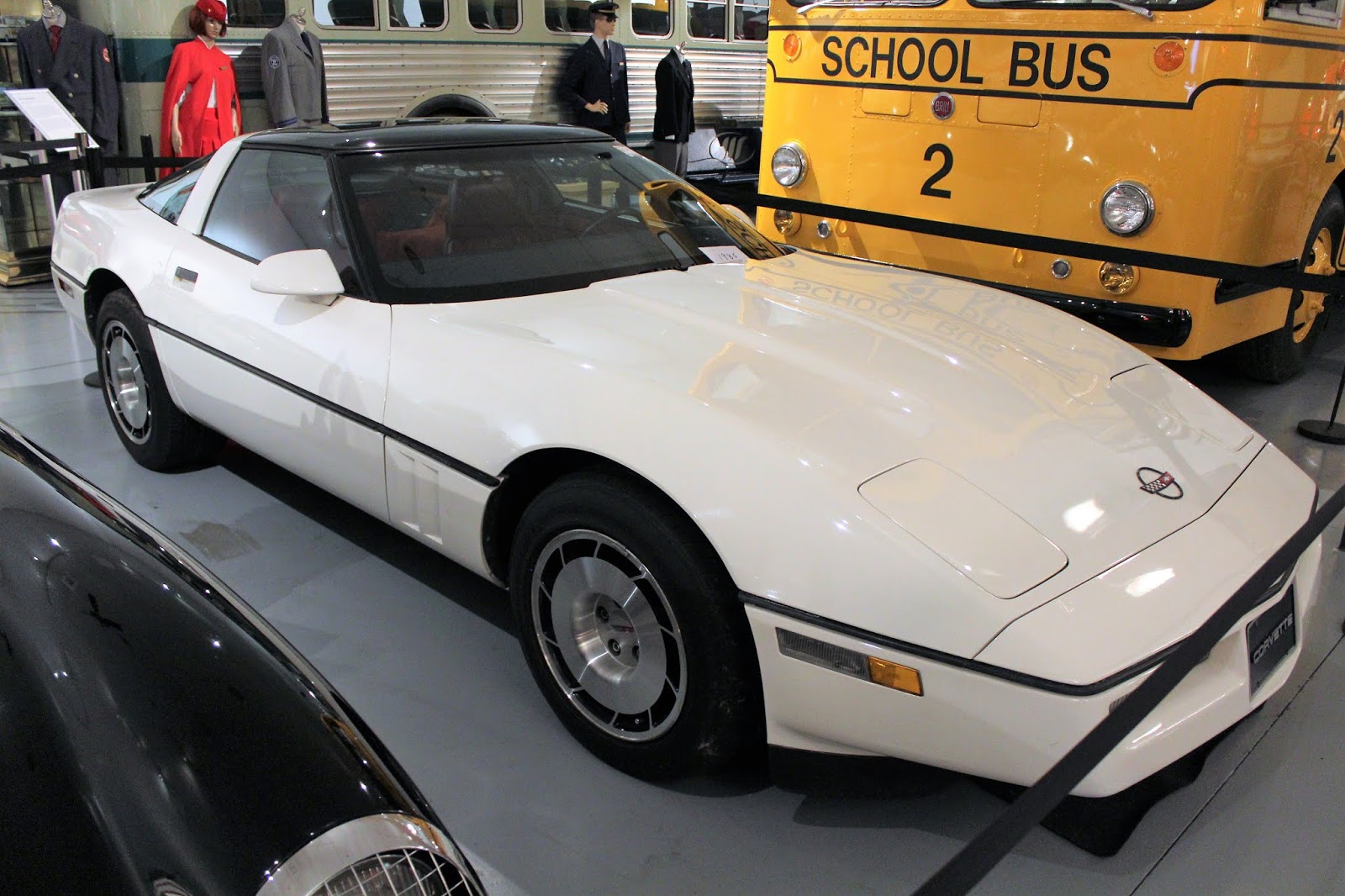
1985 C4 Corvette Coupe
After the presentation by Lance Miller, we heard from a number of other speakers, with Wes Wong, who is a Board Member of the National Corvette Museum, acting as Master of Ceremonies.  Doug Fehan and Tommy Milner were back to talk about the overall 2019 season for Corvette Racing which, alas, saw the team fail to win a single one of the 13 races entered (the WeatherTech SportsCar Championship series plus the 24 Hours of Le Mans).  It was clearly Porsche's year as that team won six of the 12 WeatherTech races, or possibly, the Balance of Performance set-up favoured their cars.  BoP is a hot topic in racing but, realistically, there is no way that such divergent cars could be made to race with each other competitively unless there was some way to equalize things.  We also heard comments from Tommy Milner about what it is like to drive the new Corvette, the mid-engined C8-R, that will be present at the 24 Hours of Daytona in January for its first race.  One of the cars will be silver with yellow details, while the other will be the traditional Corvette Racing yellow with some silver.  There seemed to be a difference of opinion as to which colour should have been used!
Driver Tommy Milner (left) and Corvette Racing Program Manager Doug Fehan (right) talking about the 2019 racing season
The program continued with a very interesting presentation by Lee Willard, the Chief Michelin Corvette Tire Engineer, who had a slide presentation about the new C8 and how the tires were developed for it, and a talk was also given by Cam Bower, Strategic Alliance Global Manager from Mobil, who spoke about the latest Mobil 1 synthetic oil technology.  Having heard representatives of these two companies at numerous events now, we are always surprised how they come up with something new and memorable to discuss.  Corvette owners are very interested in the technical aspects of their cars today but Michelin and Mobil have been with the program for years and talk about their history with Corvette as well.

The Corvette Racing Weekend then featured an auction to raise money for the National Corvette Museum, as well as some items to benefit the AACA Museum, and the Corvette fans opened their wallets with enthusiasm.  The event ended with an autograph session.  Nigel Dobbie, a super Corvette enthusiast whom we had met at the NCM's "NASCAR in the South" event in North Carolina in 2017, has just published a big book on Corvette Racing's first 20 years and we purchased a copy, which we had signed by Nigel, Doug (who wrote a foreword), Tommy and the others.
With the Corvette Racing Weekend events concluded, we were able to walk around the AACA Museum and look at the cars on display without any rush.  That evening we had attempted to go for dinner in downtown Hershey but the restaurants were packed so we ended up at Troegs Brewery yet again!

2019 Corvette Racing Weekend: Backstage at the AACA Museum, Hershey, Pennsylvania, October 26, 2019

15,000 sq ft storage "garage" of the AACA Museum

The AACA Museum (which is, oddly, not affiliated with the Antique Automobile Club of America) opened its doors in June 2003 and "is dedicated to the preservation and presentation of motor vehicle history in a manner that provides for the education and entertainment of our guests," according to its website.  This was a our third visit over the years and there are constantly changing exhibitions so we have had the opportunity of seeing different cars.  While at the museum this time for the Corvette Racing Weekend, there was a very fine collection of Studebaker cars and trucks on display.  But on this cool Saturday morning we were encouraged to go down the hill behind the museum and check out the big climate-controlled storage facility where non-display cars were being kept.

There were quite a few Studebakers in the storage building as they had been moved in order to provide space for special events, like our Corvette Racing Weekend.  There were also cars that had been loaned temporarily to the museum and not everything was labelled so in some cases I have had to guess and test my old car knowledge.

1929 Whippet Rumble Seat Roadster
This elegant and sporty little roadster was manufactured by the Willys-Overland Company in Toledo, Ohio, as well as in Toronto, Ontario, as the low-priced brand in the Willys line-up.  The cars were surprisingly advanced for the price, with good build quality and nice styling.  Willys-Overland's English subsidiary was involved in development of the car and it has very much a European light car feel to it.  When first offered late in 1926 the Whippet had a four cylinder engine but within a few months a six cylinder was offered and the company claimed this was the lowest-priced six in America at prices of around $800.    Although the smallest car in America at introduction, it was not slow, even setting a 24 hour endurance record at the Indianapolis Speedway for cars costing under $1000.  The car sold quite well, with 110,000 units the first year, helping to move Willys-Overland into third place behind Ford and Chevrolet in the US industry.  315,000 were sold in 1929 and then 295,000 in 1930 but the Great Depression was casting its shadow.  Willys-Overland decided to concentrate on a single new model, the Willys 77, and the Whippet disappeared in 1931.

The AACA Museum roadster is a very attractive car but that should not be a surprise as it was designed by a pioneer of streamline auto design.  The chief designer of Willys-Overland was Amos Northup, who is unjustly forgotten now but who was responsible for a series of attractive cars before his untimely death in 1937 after a fall on an icy sidewalk.

1950 Willys-Jeepster
Willys-Overland, after various financial struggles, eventually reestablished itself and was a bidder on an American contract in 1941 to build the versatile, off-road vehicle invented by American Bantam but for which that company was unable to undertake mass production.  The famous Willys Jeep was the result.  The company decided after World War II to stay out of the passenger car business and concentrate on utility vehicles but the Jeepster, introduced in 1948, was a civilianized Jeep with some passenger comforts.  It was styled by noted industrial designer Brooks Stevens (who signed the door of this example).  This Jeepster was returned to the factory in 1962 and re-engined, something available to VIP customers.  In all, some 19,000 Jeepsters were built between 1948 and 1950.


1927 Studebaker Commander Big Six
1913 Ford Model T "C-Cab" Truck

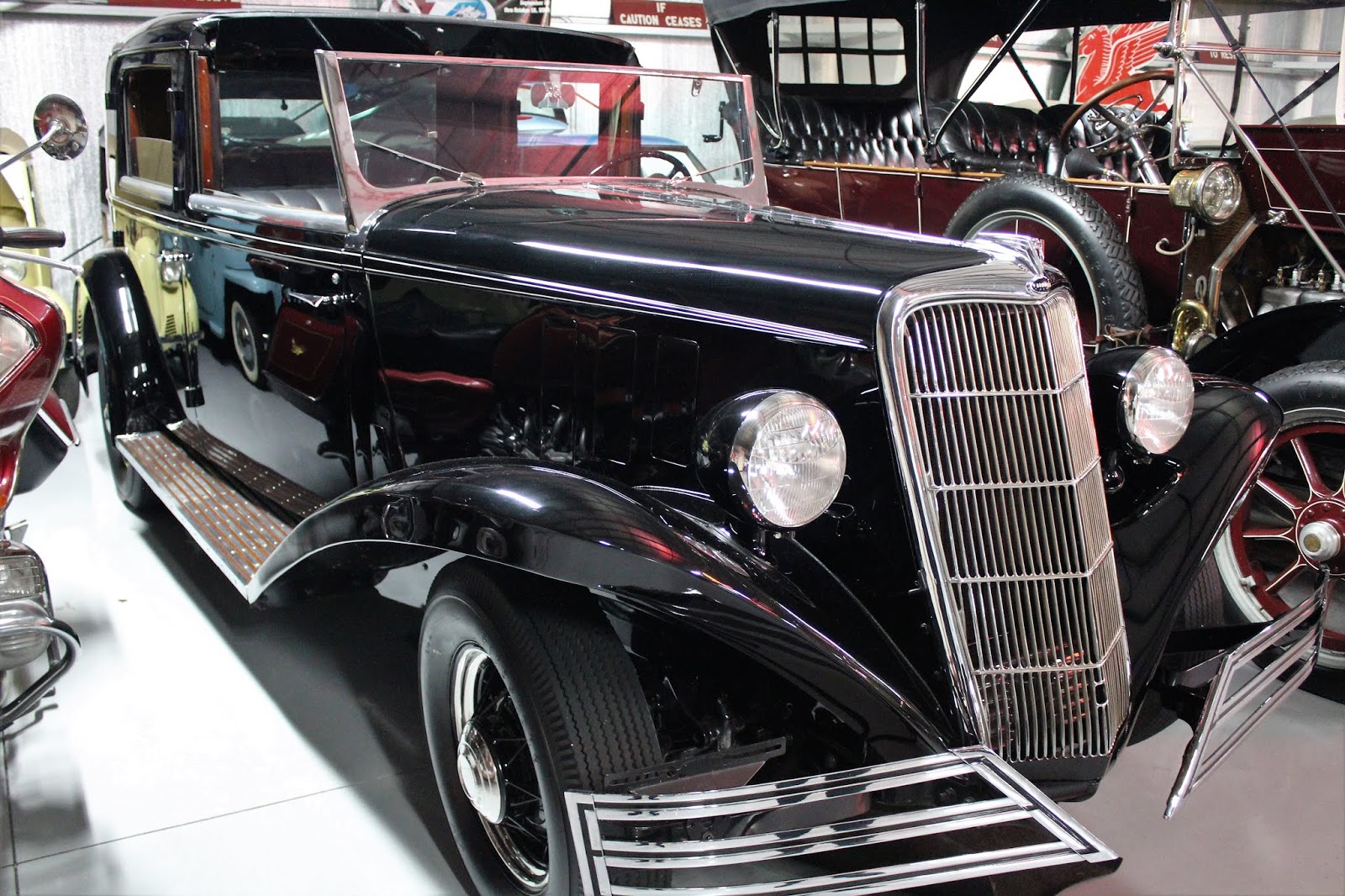
1935 Brewster Ford-Front Town Car
The historic New York carriage builder Brewster & Co. was established in 1856 and became Rolls-Royce of America's subsidiary in 1925, serving in that capacity until Rolls-Royce pulled back from its US operations in 1934.  With the Great Depression on, the managers at Brewster thought that there would be a market for cars for the wealthy that were less ostentatious and they produced a series of cars using primarily Ford V8 chassis and engines, although they would build bodies for other makes their customers brought in.  Edsel Ford brought the first Brewster and it appears that around 140 were built, in town car, limousine and convertible sedan configurations, before the company went bankrupt in 1935.  39 Brewsters are known to currently exist.


1912 Cadillac Model 30 Touring Car
 A very fine example of the first car to be sold with an electric starter, this 1912 Cadillac had only two owners previous to its donation to the museum and is in original condition, with less than 3,000 miles since new.  The base price for one of these cars would have been $1,800.

1963 Studebaker Avanti


Customized Studebaker Hawk Roadster


1933 LaSalle Coupe

1929 Packard Model 633 Five Passenger Touring Car
1930 DeSoto

The DeSoto was introduced by Chrysler in 1929 and immediately set sales records.  It was intended to fill the gap between the Chrysler and Plymouth brands at a time when Chrysler was negotiating the purchase of Dodge and wanted to pressure the bankers selling as the Dodge cars would have fit into the same slot but in the end Chrysler ended up with both brands.  DeSoto's first year sales record of over 81,000 cars was not to be matched until the introduction of the Ford Falcon in 1960, ironically the same year that the DeSoto line was discontinued.  The AACA Museum's example is a Series CF eight cylinder sedan that would have sold for around $1,000.


1914 Packard 3-48 Limousine
This magnificent Packard was donated to the museum without a radiator but in 2013 the museum was able to have a family-owned radiator and repair shop in Lancaster, Pennsylvania, build a replica using blueprints from the Studebaker Museum and a 1915 Packard as a model.  The radiator was donated to the museum by the shop, which allowed the car to actually be operated.  The 3-48 featured a 525 cu. in. six cylinder motor producing 82 hp, left hand steering, and mechanical brakes only on the rear wheels.  There were fourteen available body styles and a choice of no less than 42 colours.  This limousine would have cost $5,900 in 1914, or the equivalent of $152,000 in current US$.


1928 Pierce-Arrow Model 36 Limousine
Produced from 1926 to 1928, the Pierce-Arrow Model 36 was powered by a 100 hp 414 cu. in. T-head 24 valve six cylinder engine.  Constructed to the highest standards of the day, around 1,900 Model 36s were built in numerous body styles.  This particular car was once owned by Paramount Studios and was used to ferry actress Marlene Dietrich to work.


c. 1928 Chrysler Sedan


1930 Cord L-29 Cabriolet


1929 Stearns-Knight Model J8-90
A very fine example of another nearly forgotten luxury marque that fell to the Great Depression, this Stearns-Knight would have sold for $5,500, or ten times the cost of a Ford Model A.  The first Stearns cars were produced in Cleveland, Ohio, in 1901 by the F.B. Stearns Company, and the brand became Stearns-Knight in 1911 when the company licensed the Knight sleeve valve engine, favoured for its quiet running.  In 1925 the company became part of the empire of John North Willys as a non-integrated affiliate of Willys-Overland.  The J8-90, built on a 145 inch wheelbase, was powered by a 125 hp 8 cylinder engine, and was available as seven passenger touring car, sedan or limousine.  Production of Stearns-Knight autos ended in 1929.


1922 Brockway LaFrance Fire Truck
Founded as a carriage maker in 187 in Cortland, New York, Brockway went into the motor vehicle business in 1909 and operated independently as a truck builder until purchased by Mack Trucks in 1956.  Production of Brockway trucks ended with closure of the Cortland factory in 1977.  Brockway supplied Torpedo chassis to American-LaFrance in Elmira, New York, for production of the chemical and hose trucks primarily for volunteer fire departments.


1931 Ford Model A Deluxe Roadster


"1908 Empire"--a mystery car?
This is a "1908 Empire," according to the hand-written sign on the seat, but no further details can be found anywhere.  From its primitive look, I believe it is an earlier car, although Sears did introduce its Motor Buggy with high wooden wheels and tiller steering in 1908, producing them until 1912 .  A company called Empire State Automotive in Rochester built a somewhat similar car between 1900 and 1901 but with tiller steering and bicycle-type wire wheels.

1939 American Bantam
1965 Lincoln Continental Sedan


1936 Packard 120-B Convertible Sedan
Famed luxury car manufacturer Packard entered the mid-priced field in 1935 with the Model 120,  This car features a body style introduced in 1936, a year in which 55,000 120-Bs were sold, doubling the previous launch year's sales.

1929 Plymouth Model U Rumble Seat Coupe

1916 Woods Mobilette

The Woods Mobilette cyclecar was built in Harvey, Illinois from 1913-1916 and this No. 5 model, introduced in 1916, featured staggered seating, a four cylinder 12 hp engine and electric lights and starting as an option.  The cyclecar fad ended rapidly (although Woods claimed to be producing 1,000 cars a month in 1914).  The Mobilette at $380 was not competitive with the Ford Model T, which by 1916 was $20 less than the Woods!  The company had one of the weirdest marketing slogans ever: "Built like a watch, and ownership will not cause Tuberculosis of one's wallet!"
1910 Buick Model 10 Surrey


1933 Chrysler Model CO


1941 Chevrolet Special Deluxe Convertible


1907 International Harvester Model B Farmer's Auto
Between 1907 and 1911, farm implement maker International Harvester sold 4,500 of these popular, rugged high-wheelers, simply replacing a buggy's horse with a two cylinder 16 hp motor.  Suitable for unimproved roads, the Farmer's Auto sold for $600.


1931 Cadillac Four Door Town Sedan


1926 Packard Five Passenger Club Sedan
The Club Sedan body style was new for Packard in 1926 and this example was built by the Dietrich body company.  Costing $2,275 and powered by a six cylinder 80 hp engine, this car was used in the television series "Boardwalk Empire" as mobster Al Capone's car.

1910 Brush Model D Runabout

1938 Lincoln Model K Convertible
One of the first cars donated to the AACA Museum, this V12 Lincoln was found in a barn and was the subject of a 13 year restoration.  Eight examples were built in this body style by coachbuilder Brunn of Buffalo and two remain extant today.

1926 Wills Sainte Claire
Between 1921 and 1926 some 12,000 Wills Sainte Claire cars were built by former Henry Ford associate C. Harold Wills, a painstaking engineer who was not tuned to business realities.  The cars were beautiful and expensive but not profitable in the end.  80 are believed to still exist.


1941 Lincoln Zephyr
This fabulous car began as one of 295 Lincoln Zephyr limousines built on an extended wheelbase and is thought to be the only one existing that was converted to an ambulance.  The builder is unknown.  The car saw duty in California in the 1940s and 1950s.

1924 REO T-6 Funeral Hearse
Believed at one point to have been used to haul bootleg liquor during Prohibition, this hearse was carefully restored to become a "mobile party vehicle."  It features a coffin in the interior that opens up to be a wet bar.  Yet another AACA Museum car used in "Boardwalk Empire." Very appropriate.


1965 Lincoln Continental Convertible

1928 Oldsmobile F-85 Roadster
Another veteran of the "Boardwalk Empire" television series, this Oldsmobile marked the first year of the F Series, with a 55 hp six cylinder engine and a longer chassis.  Twelve body styles were available.


1947 Muntz Kaiser Pickup Truck
In 1947, marketing celebrity and Kaiser-Frazer dealer Earl "Madman" Muntz suggested to Henry Kaiser that there could be a market for upscale pickup trucks.  Three four door Kaiser-Frazer sedans were cut up and turned into pickups but Muntz discovered the interest was not there so he ended up keeping one of the pickups as a service truck, powered with a Pontiac engine.  This last surviving concept truck was purchased by a custom car builder in 2000 and modified in fine hot rodder style


1926 Essex/Ford Racer
Built on an Essex frame and using a Ford Model A race engine, this midget racer was built in the 1960s.